Can all-photonics networks make offshore computing more practical?
Why this matters:
-
As offshore facilities generate and process more data, connectivity is becoming as important as power and physical infrastructure.
-
Improved network performance could help support AI, remote operations and autonomous technologies across offshore oil and gas and wind assets.
-
APNs are being explored as a way to make offshore computing and digital infrastructure more practical at scale.
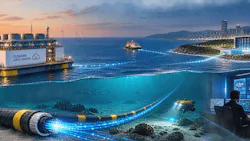
What is an all-photonics network (APN)?
An APN is a communications architecture designed to keep data in the optical domain for as much of its journey as possible, reducing the need for repeated optical-to-electrical signal conversions.
Key hurdles for offshore data centers include high construction costs, regulatory challenges and integration with terrestrial networks. Industry collaboration and technological advancements are essential for viability.
Ralph Rodschat, board member of the IOWN Global Forum and vice president of global sales engineering at Ciena, explained to Offshore how all-photonics networks (APNs) could improve connectivity for floating offshore data centers and other offshore digital infrastructure.
Offshore: In practical terms, how does an APN differ from a conventional network architecture, and what could it offer offshore data centers?

Rodschat: A conventional network converts traffic between optical and electrical form at several points for routing and processing. These points can cause delay, buffering and variation in performance.
An all-photonics network (APN) is designed to keep traffic on more direct optical wavelength paths. This reduces avoidable network overhead and makes performance more predictable.
For an offshore data center, that could support reliable links to onshore users, cloud regions and operations teams. It could also help with distributed compute, replication and remote control.
Offshore: What lessons from the Taipei to Tokyo deployment by NTT and Chunghwa Telecom are most relevant to future offshore or floating data center applications?
Rodschat: The Taipei to Tokyo deployment by Chunghwa Telecom and NTT provides a strong demonstration of what APNs can achieve over a long-distance subsea route. While the deployment connects terrestrial facilities rather than offshore data centers, it demonstrates that APN technology can support high-capacity, predictable connectivity across significant distances.
For future offshore applications, this provides confidence that subsea fiber can support demanding digital workloads while maintaining stable performance. It also shows how APNs could provide the connectivity between remote offshore infrastructure and onshore facilities.
Offshore: To what extent can APNs mitigate the latency challenge, and what limitations remain?
Rodschat: For offshore data centers, APNs can help create the high-performance connectivity needed to integrate remote computing infrastructure with the wider digital ecosystem. Offshore data centers will need to function as an integral part of land-based infrastructure and, therefore, will need to leverage the benefits of APNs to scale across applications.
By reducing network processing and overhead, APNs can support more responsive and predictable connections between offshore facilities, onshore infrastructure and users. This could make offshore locations more practical for cloud, AI and other data-intensive applications, particularly where consistent network performance is important.
APNs can also help make better use of existing subsea fiber infrastructure, allowing operators to improve network performance through upgrades to optical switching and terminal equipment. The distance between an offshore data center and terrestrial infrastructure will require optimized optical interfaces to deliver the best possible energy efficiency and throughput. APNs can support this requirement by using high-performance optical signals across both proprietary and open interfaces. For instance, Ciena’s WaveLogic 6 Extreme (WL6e) is built to align with IOWN APN principles and best practices, supporting high-performance, energy-efficient optical transport across both proprietary and open networking environments. This combination of efficient connectivity and predictable performance could help address some of the networking challenges associated with locating data centers offshore.
Offshore: What are the biggest challenges before offshore data centers can become commercially viable?
Rodschat: The biggest hurdles extend beyond the technology itself. Construction and operational costs will be important in determining whether offshore data centers can deliver a compelling commercial proposition compared with established onshore infrastructure.
Operators will also need to consider how these facilities can be built and managed effectively in an offshore environment. Regulation is another significant consideration, with projects requiring appropriate frameworks and approvals before they can operate at scale.
The need to interwork with existing service provider and hyperscale networks on the terrestrial connection to any offshore data center also presents an opportunity to use the APN Domain Interconnect (ADI) approach, enabling end-to-end photonic services to transit multiple operators or multiple photonic vendor systems.
Ultimately, the business case needs to demonstrate that the benefits of locating computing infrastructure offshore to justify the additional complexity and investment involved.
Addressing these challenges will require close collaboration across the industry and with regulators. As the technology and operating models develop, offshore data centers could become a practical option for expanding digital infrastructure in locations where they can offer a clear commercial advantage.
Related content:
 Tampnet Connected Platform
 offshore_magazine_image_final
About the Author
 Ariana Hurtado
Ariana Hurtado
Editor-in-Chief
With more than a decade of copy editing, project management and journalism experience, Ariana Hurtado is a seasoned managing editor born and raised in the energy capital of the world—Houston, Texas. She currently serves as editor-in-chief of Offshore, overseeing the editorial team, its content and the brand's growth from a digital perspective.
Utilizing her editorial expertise, she manages digital media for the Offshore team. She also helps create and oversee new special industry reports and revolutionizes existing supplements, while also contributing content to Offshore's magazine, newsletters and website as a copy editor and writer.
Prior to her current role, she served as Offshore's editor and director of special reports from April 2022 to December 2024. Before joining Offshore, she served as senior managing editor of publications with Hart Energy. Prior to her nearly nine years with Hart, she worked on the copy desk as a news editor at the Houston Chronicle.
She graduated magna cum laude with a bachelor's degree in journalism from the University of Houston.