Operators confront equipment obsolescence on aging offshore assets
Key highlights:
-
Supportability, not age alone, increasingly determines the operating life of offshore equipment.
-
Operators are managing growing risks related to control-system obsolescence, spare-parts availability and knowledge retention.
-
Strategic inventory planning and OEM remanufactured parts can help reduce downtime and extend asset life.

Offshore operators around the world are extending the lives of production assets well beyond their original design expectations. But according to Paul E. McGill II, president and co-founder of MCGILL Industries Inc., the greatest challenge is often not the mechanical condition of compressors, engines and other critical equipment. Instead, long-term reliability increasingly depends on maintaining access to parts, controls, technical expertise and the documentation needed to keep aging systems supportable.
In this Offshore exclusive Q&A, McGill discusses equipment obsolescence, spare-parts strategies and the growing role of knowledge preservation in offshore life-extension programs.
Offshore: Many offshore fields are operating well beyond their original design lives. From your perspective, how has the conversation around equipment maintenance and reliability changed as operators pursue longer asset life-extension programs?

McGill: What I've seen over the years is a shift from maintaining a machine until the next overhaul to asking whether the complete system can remain supportable throughout the facility's remaining life. Mechanical condition is still fundamental, but operators now have to consider control obsolescence, parts continuity, accumulated modifications, technical records, specialist availability and the offshore logistics needed to execute the work.
Operators are also looking further ahead. At a major overhaul, a manufacturer-supported upgrade may be preferable to restoring the original configuration. Depending on the application, it can improve protection, diagnostics, fuel control, efficiency or available power without requiring a completely new package.
Offshore, however, even a well-developed upgrade needs an early review of piping, cooling, exhaust, electrical demand, hazardous-area requirements, structural capacity, lifting and commissioning. Life extension has become a multidisciplinary asset decision rather than a maintenance event.
Offshore: What are the most common obsolescence challenges you see today for engines, compressors, turbines and associated control systems on mature offshore assets?
McGill: In our experience, controls often become unsupported before the major mechanical components. Legacy processors, circuit boards, displays, communication modules, sensors and software may be unavailable or incompatible with current replacements.
Where a supported migration path exists, upgrading to a current control platform is usually preferable to relying on a used or repaired board. A legacy board may provide temporary recovery, but a planned update can restore supplier support, documentation, diagnostics and parts availability. The migration must verify input and output interfaces, software logic, communications, protection settings and hazardous-area requirements.
On the mechanical side, the challenge is more often keeping up-to-date with product improvements rather than the disappearance of major components such as castings or crankshafts. Manufacturers introduce reliability improvements, such as cylinder heads with improved cooling. These upgrades can be worthwhile, but operators must confirm whether related components or interface changes are required.
Configuration uncertainty compounds the problem. After decades of field changes, the installed equipment may not match the original bill of material or drawings. Operators need accurate serial numbers, parts revisions, application drawings, software, control settings and approved alternatives. They also need to preserve knowledge as technicians experienced with older mechanical, pneumatic and analog systems retire.
Offshore: Supply chain disruptions exposed vulnerabilities across the energy industry. What lasting changes have you seen in how offshore operators source spare parts and manage inventory for critical rotating equipment?
McGill: Operators can no longer assume common parts will be readily available when they need them.
The stronger programs identify critical items before failure, qualify more than one technically acceptable supply or repair path where possible, retain repairable cores and obtain documentation while it is still accessible. They also account for the complete delivery chain: inspection release, export paperwork, transport, customs, vessel or helicopter schedules and final offshore handling.
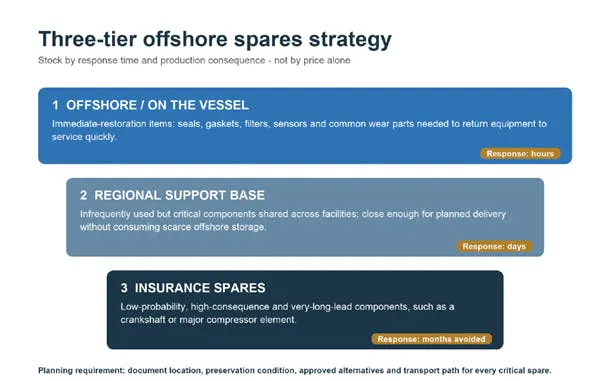
Inventory is increasingly tiered by response time and consequence. Immediate-restoration items belong on the facility; less frequently used critical items can sit at a regional base serving several assets; and low-probability, high-consequence components with extreme lead times may justify insurance-spare status.
Shared fleets can benefit from standardized components, exchange pools and supplier-held stock, provided ownership, release authority and delivery commitments are explicit.
Offshore: Looking ahead five to 10 years, what will be the biggest mechanical integrity and equipment life-cycle challenges facing operators of aging offshore facilities around the world?
McGill: The mechanical challenge is not simply the age of the machine. Wear components are designed to be replaced as part of normal maintenance. The greater life-extension concern is corrosion and whether changes in load, pressure, gas composition or operating pattern have moved the machine beyond its original duty.
At the same time, electronic modules, software, control settings and diagnostic tools need the same preservation discipline historically applied to drawings and physical spares.
The other major challenge is knowledge continuity. Equipment history, field modifications, repair procedures and control settings must be captured while experienced personnel remain available. No single age makes a machine unsuitable; condition, duty, criticality, maintenance burden, efficiency, emissions, parts availability and technical support all matter. Some mechanically repairable machines will ultimately be retired because they can no longer be supported with reasonable confidence.
Offshore: Can you share a real-world offshore example where an operator successfully avoided downtime, extended equipment life or improved reliability through a different approach to parts sourcing, remanufacturing or maintenance planning?
McGill: A recent parts-sourcing assignment with an offshore operator illustrates the value of considering genuine manufacturer-remanufactured parts early rather than treating them as an emergency substitute. The program required genuine Cat parts, but several new parts carried delivery dates months away or no firm availability date. Waiting only for new production would have left the maintenance schedule dependent on uncertain lead times.
We reviewed the required components against the Cat Reman program and identified genuine Cat Reman alternatives where they were available. Among the substitutions were an engine oil pump and an auxiliary water pump. The alternatives still required confirmation of interchangeability, core-return requirements, availability and shipping status, but they provided a manufacturer-supported way to keep the parts program moving. They also reduced the operator’s net maintenance cost because credits were received for returning eligible used components as cores.
The practical lesson is to evaluate new and genuine remanufactured options at the start of the sourcing process. A suitable remanufactured part can avoid waiting months, or for an indefinite period, for a new part. It can also reduce maintenance costs and give the maintenance team a firmer basis for planning the work, provided the correct alternative is verified and approved before the schedule is committed.
About the Author
 Ariana Hurtado
Ariana Hurtado
Editor-in-Chief
With more than a decade of copy editing, project management and journalism experience, Ariana Hurtado is a seasoned managing editor born and raised in the energy capital of the world—Houston, Texas. She currently serves as editor-in-chief of Offshore, overseeing the editorial team, its content and the brand's growth from a digital perspective.
Utilizing her editorial expertise, she manages digital media for the Offshore team. She also helps create and oversee new special industry reports and revolutionizes existing supplements, while also contributing content to Offshore's magazine, newsletters and website as a copy editor and writer.
Prior to her current role, she served as Offshore's editor and director of special reports from April 2022 to December 2024. Before joining Offshore, she served as senior managing editor of publications with Hart Energy. Prior to her nearly nine years with Hart, she worked on the copy desk as a news editor at the Houston Chronicle.
She graduated magna cum laude with a bachelor's degree in journalism from the University of Houston.