Petrobras field trials demonstrated real‑time offshore hydrocarbon detection and reduced false alarms
Key highlights:
- The technology utilizes hyperspectral laser-induced fluorescence LiDAR for real-time, molecular-level oil detection at sea, independent of weather and lighting conditions.
- The system educes false positives by distinguishing hydrocarbons from look-alike phenomena, enabling quicker and more accurate spill response decisions.
- Field trials have shown significant improvements in early detection, reducing unnecessary responses and improving situational awareness for offshore teams.
Bekkmo is a master mariner with a master's degree in finance. He has nearly four decades of experience in the offshore industry, with previous roles spanning, but not limited to, senior financial planner with the Norwegian Ministry of Defence, CFO of J.B. Ugland Shipping AS, senior marine/DP surveyor with Aqualis Offshore, and business development lead with Oceaneering. This is all after serving 17 years with the Royal Norwegian Navy.
Offshore: How does Ocean Visuals’ LiDAR-based oil spill detection system differ from traditional monitoring methods in terms of accuracy and response time?

Bekkmo: Traditional offshore spill monitoring typically relies on satellite imagery, radar, visual observation and manual sampling. While these methods are well established, they can often be limited by weather conditions, daylight, revisit frequency and the time required to verify observations through laboratory analysis.
Ocean Visuals uses hyperspectral laser-induced fluorescence (HLIF) LiDAR to illuminate the sea surface and near-surface water column. This enables detection and classification of hydrocarbons in real time, independent of light conditions. By measuring fluorescence signatures, the system can differentiate hydrocarbons from look-alike phenomena such as biological material or surface sheen, reducing the risk of false positives compared with radar-only indications.
Operationally, this approach reduces the time from detection to verification and decision-making, particularly in situations where traditional methods would require sample collection and laboratory confirmation.
Offshore: How do you see advanced sensor technologies influencing compliance with emerging HSE regulations and international standards for offshore oil and gas operations?

Bekkmo: Across many jurisdictions, there is a clear direction toward stronger expectations for environmental monitoring, documentation and traceability. Advanced sensor technologies can support this trend by providing continuous, objective measurements rather than relying solely on periodic observations or post-event analysis.
Real-time monitoring data can complement existing compliance frameworks by improving transparency, supporting incident investigations and strengthening environmental reporting. As regulatory regimes increasingly emphasize data-driven oversight, sensor systems that provide time-stamped, verifiable measurements are likely to play an expanding role in offshore HSE practices.
Offshore: What are the biggest challenges in integrating hyperspectral laser-induced fluorescence systems into existing offshore infrastructure, and how is Ocean Visuals addressing them?
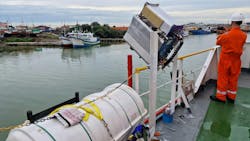
Bekkmo: Ocean Visuals has focused a plug-and-play modular system design and compatibility with standard offshore vessels and platforms. Systems are designed for installation on the side of vessels or fixed installations, and data outputs are structured for integration with existing GIS systems. Ensuring reliability in harsh offshore conditions is addressed through design and extensive field testing under real operational scenarios. For drones, the systems are lighter and designed slightly differently than the onboard systems.
Offshore: Your technology provides molecular-level detection without lab sampling. How does this capability transform decision-making during spill response and incident verification?
Bekkmo: By removing the dependency on laboratory analysis, molecular-level detection can significantly shorten the time between detection and operational decision-making. Verification and classification occur directly at sea, allowing operators to assess whether a detected feature is oil and to characterize it more precisely.
[It provides] the instant detection of oil (or not) to depths of up to 10 feet and the possibility to display this information in a map system. For larger spills, this enables quicker response times and more accurate deployment of resources, because the recovery teams instantly have information where the oil is.
Offshore: Ocean Visuals operates across multiple regions and collaborates with organizations like Petrobras and NOAA. How do regional environmental policies shape technology adoption in offshore energy markets?
Bekkmo: Environmental policies differ by region, but there is a common trend toward increased environmental oversight and higher expectations for monitoring and documentation. In mature offshore markets, regulators and operators increasingly emphasize early detection, traceability and data quality.
Collaboration with organizations, such as Petrobras and NOAA, reflects how regional regulatory frameworks, environmental conditions and response requirements influence how monitoring technologies are evaluated and adopted. Local policy priorities often shape both operational use cases and the performance criteria applied during field trials.
Offshore: Can you share insights from recent offshore field trials or case studies where your technology demonstrated measurable improvements in spill detection or environmental monitoring?
Bekkmo: In offshore field trials conducted in collaboration with Petrobras, the system was deployed on an offshore spill response vessel operating near active offshore assets. The trials demonstrated continuous, real-time detection and classification of hydrocarbons under operational conditions, without the need for water sampling or laboratory verification.
One operational outcome was a reduction in false alarms compared with radar-only indications, helping avoid unnecessary responses in certain situations. The system also enabled earlier detection of low-concentration hydrocarbons, improving situational awareness for offshore operations teams.
Petrobras’ research team noted the operational implications in post‑trial feedback:
"The operational use of this technology has the potential to improve the verification of suspicious oil features, the detection of oil in the water column, reducing the need for conventional laboratory analysis. To conclude, we have high expectations regarding the services offered by Ocean Visuals."
—Dr. Cristina Maria Bentz, Master Geophysicist, Department of Health, Environment and Safety Technologies, Petrobras Research Center
Offshore: Beyond oil spill detection, what other applications do you foresee for hyperspectral sensing in offshore energy, including renewables?
Bekkmo: Beyond oil spill detection, hyperspectral fluorescence sensing can detect the difference between real and counterfeit lubricants. It may also support seismic operations detecting underwater seeps, and it can be used to ensure water purity to protect critical water supply infrastructure.
About the Author
 Ariana Hurtado
Ariana Hurtado
Editor-in-Chief
With more than a decade of copy editing, project management and journalism experience, Ariana Hurtado is a seasoned managing editor born and raised in the energy capital of the world—Houston, Texas. She currently serves as editor-in-chief of Offshore, overseeing the editorial team, its content and the brand's growth from a digital perspective.
Utilizing her editorial expertise, she manages digital media for the Offshore team. She also helps create and oversee new special industry reports and revolutionizes existing supplements, while also contributing content to Offshore's magazine, newsletters and website as a copy editor and writer.
Prior to her current role, she served as Offshore's editor and director of special reports from April 2022 to December 2024. Before joining Offshore, she served as senior managing editor of publications with Hart Energy. Prior to her nearly nine years with Hart, she worked on the copy desk as a news editor at the Houston Chronicle.
She graduated magna cum laude with a bachelor's degree in journalism from the University of Houston.