Oceanographic monitoring in real time addresses GoM currents concerns
Pilot deepwater data study planned
Afully integrated monitoring solution ensures the structural integrity of floating production installations and associated equipment. Sicom Solutions, part of Norway’s Sicom Group, has developed the technique in partnership with Stress Engineering Services and Woods Hole Group. Among other benefits, the structural integrity assurance package ensures compliance with oceanographic monitoring requirements in the Gulf of Mexico, according to Sicom Solutions’ president Else Terry.
In April, the US Minerals Management Service introduced regulations requiring operators with deepwater installations to conduct oceanographic monitoring, reporting currents in excess of one knot near the seabed. The new rules have been prompted by concerns that there is insufficient knowledge about deepwater currents, including the GoM’s well-known loop currents and the possible long-term fatigue effects these may have on installations and equipment.
With its partners, Sicom is negotiating with a leading GoM operator to implement a pilot data gathering project at the site of a deepwater production installation.
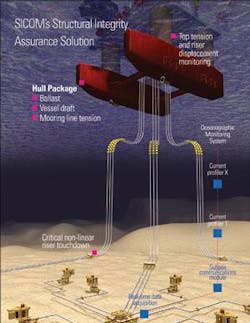
Sicom’s package combines both oceanographic and structural integrity monitoring. The typical configuration provides monitoring of vessel motions, positioning, mooring, wind and waves, full water column current profile in real time, riser vortex-induced-vibrations (VIV), touch-down, and topside tensioners. No other supplier offers real-time oceanographic monitoring, Terry says. All oceanographic data acquisition units are linked by power cable, with battery back-up to guard against power failure.
MMS’ requirement for collecting current data at locations where a floating production installation is due to be installed is sensible, according to Terry.
“Platform designs have been subject to costly over-dimensioning due to a lack of precise knowledge of the environmental conditions at the location where they are to be installed,” she says. “Taking in accurate and reliable oceanographic data at the design stage can help avoid unnecessary expense and, more importantly, aid in increasing the safety of the installation.”
The cumulative effects of wind and current loading on the structural integrity of floating production facilities cannot be measured without effective continuous monitoring. “Our solution allows evaluation of the distribution and rate of fatigue damage accumulated from diverse loading conditions over the life of the field, allowing predictive analysis of the facility to drive scheduled maintenance and reduce risks,” Terry says.
“With this method the operator will have accurate information and confidence to incorporate the maximum number of tiebacks and auxiliary equipment to the facility, safely and in the most economical manner.”•