Kristin partners surmount hurdles of subsea HP/HT production
Well performance forces change in drilling strategy
Nick Terdre
Contributing Editor
When Statoil’s Kristin field comes on stream this October, it will represent a major advance in high-pressure/high-temperature production. When development was approved in December 2001, Kristin was considered the most ambitious HP/HT scheme ever attempted, involving subsea wells tied back to a floating production platform.
The project also marks a further stage of resource development on the western Halten Bank in the Norwegian Sea. Kristin will use the existing Åsgard field infrastructure to export its gas and condensate to shore, and will also act as a hub for future developments in the area.
Saga Petroleum discovered the field in 1996 via exploration well 6406/2-3S. Subsequently appraisal revealed an extension into Statoil’s 6506/11 block to the north. Interests in the two licenses, PL 199 and PL 134, have been unified provisionally as follows: Statoil 41.6%, Petoro, manager of the State’s Direct Financial Interest, 18.9%, Norsk Hydro 14%, ExxonMobil 10.5%, Eni 9%, and Total 6%.
Following reassessment of the distribution of the field’s reserves, the participating companies will re-align equity, and revise the official reserves estimate. . At present, the figures detailed in the Plan for Development and Operation (PDO) are 42 bcm of gas and 220 MMbbl of condensate.
These reserves lie in the Garn and Ile formations. Reservoir pressure is 910 bar and the temperature 170° C, conditions which have posed major challenges for the development team in terms of technical, commercial, health, safety, and environment demands. Another issue was the water depth of 315-375 m, which made use of a fixed platform impossible.
But Statoil had faced these types of challenges on previous HP/HT field projects. The most recent projects were Huldra, which came onstream in 2001, and Kvitebjørn which came onstream in 2004, both developed with fixed platforms. The company also benefited from knowledge transfer through participation in the North Sea operators HP/HT forum.
Drilling strategy
The drilling strategy in the PDO called for all 12 subsea production wells to be mainly vertical, with deviations restricted to 60o. Drilling under extreme HP/HT conditions entails major difficulties - there is a narrow window that has to be adhered to between formation fracture pressure and pore pressure. Optimizing mud weight to maintain control without damaging the formation is also highly demanding, according to drilling operations manager Dag Breivik.
At the same time, Kristin’s partners were concerned that if drilling and completion continued after the field had been brought onstream, the recovery factor could be significantly reduced. They agreed, therefore, to drill and complete all wells before start-up.
The partners chartered two high-spec semisubmersible rigs to drill the wells. Saipem’sScarabeo 5, which began work in August 2003, has been drilling some of the wells and handling all completions, while Smedvig’s West Alpha, which started its program in January 2004, has been engaged purely in drilling.
As the development advanced, drilling in the Garn formation revealed much lower permeability than had been expected, implying a lower than anticipated level of recovery. The partners decided that the five wells targeting this formation should, therefore, feature nearly horizontal sections, with deviations up to 85°. However, this also meant that the time needed to drill these wells would be considerably longer than planned, in which case all the wells would not be completed by the planned start-up date.
To ensure the schedule stayed on track, Statoil changed strategy, opting instead for a phased start-up. The new approach allows for a 100 bar depletion of the reservoir while drilling and completions operations continue. A special project team will develop procedures for operating in these conditions.
The success of this approach will only become clear after production begins, but so far operations have proceeded efficiently and safely. The team has developed a comprehensive well control manual, which Breivik describes as an industry marker. “We have set a standard for HP/HT drilling and procedures,” he says.
Not all the surprises have been negative. In one of the early wells, Statoil took the opportunity to check out the Tofte formation that underlies Garn and Ile. It proved to hold substantial additional reserves. Tofte is not in communication with the other formations, so producing it will not affect the pressure.
The first well drilled into the northeast segment produced results that are hard to interpret. It will not be put on production, but may be sidetracked, Breivik says. In-place reserves in this segment are likely to be below previous estimates.
By mid-2005, the partners had installed 9 7/8-in. casing i in most of the wells. They also had completed two wells, which were due to be tested in July. Some of the operations have gone very well, Breivik says. The partners completed the first well (within the Garn formation) with an operational uptime of 91%. On the Tofte well, the rig crew achieved a drilling rate of 131 m/day.
All downhole equipment has been subject to extensive qualification and testing. At times this has delayed delivery, but the thorough preparation has proved beneficial, with completions operations in particular going well to date.
There appears to have been a good team between operator, contractor, and service company. Operations have also benefited from the support of an onshore drilling center receiving data in real time and communicating through video conferencing facilities.
Subsea pressure integrity
The partners are placing the wells on four templates, each weighing 200 tons. Two of these house four wells, and the others two wells each. One of the two-well templates is in the northern part of the field, and the others centrally. Kværner Oilfield Products supplied the subsea equipment, including templates, subsea trees, wellheads and controls.
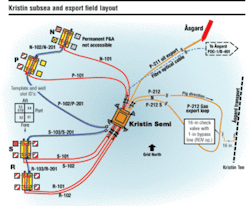
There are six flowlines, each 6-7-km long, and each serving two wells. Technip Offshore’s reelshipCSO Apachelaid these last year.
Managing the HP/HT of the wellstream from templates to topsides has also been a major challenge, according to Arne Bye, one of the four platform managers. Subsea chokes reduce the wellstream pressure by 160-240 bar before entry into the flowlines, which have a design pressure of 330 bar. The partners also fit each flowline with two high-integrity pressure protection systems (HIPPS), which automatically cut off flow if pressure exceeds a critical point. Pressure drop in the flowlines and flexible risers means that when the wellstream reaches the separator on the platform, its pressure is a manageable 90 bar.
Insulation on the subsea manifolds and flowlines has been designed to ensure that the temperature of the wellstream will drop to no more than 132° C by the time it reaches the risers, which is their design limit.
The subsea trees and HIPPS systems constitute two barriers countering excessive wellstream pressures, Bye says. A third is the platform’s flare system. Should shutdown of one of the flowlines fail, the wellstream - on reaching the topsides - will be diverted to the flare system.
Flow assurance involves use of mono ethylene glycol (MEG) injection. Originally methanol was to be used, but the partners favored MEG, which does not have the same toxic properties as methanol, and which does not cause wear and tear on equipment such as valves.
The partners will only use MEG in the event of a production shutdown, when they will inject it at the wellheads and in the flowlines. A direct electrical heating system on the flowlines will warm the wellstream and melt any hydrates that have formed before production resumes, Bye says.
Platform guidelines
The guiding principle for the construction of the platform, which is based on the Kværner GVA 50 design, has been a no-change philosophy. Adhering to this rule has in itself been a challenge, Bye says, but the platform project started well with a good early definition phase, and execution has benefited from this approach.
Only two significant changes have occurred since construction began. To cope with an increased topside load, the partners increased displacement by about 1,000 tons to 56,600 tons through adding sponsons to the columns. This took place during hull construction at Samsung Heavy Industries in Korea.
Secondly, following the discovery in another gas production operation that mercury compounds were being deposited on the heat exchanger equipment, the partners decided to remove mercury from Kristin’s gas. This led to the addition of two fairly large filter systems.
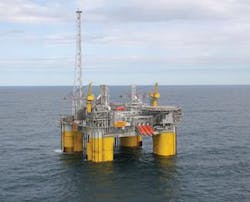
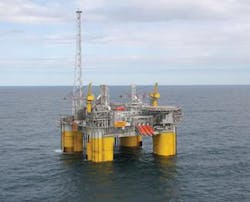
The partners installed the semisubmersible platform was installed on the field in April and commissioning of production systems was due to get under way in July. On delivery, the topsides weighed 17,500 tons and the hull 14,450 tons. Topside structures include a 6,500-ton process module, a 5,450-ton utility module, a 4,300-ton riser balcony, a 280-ton flare tower, and a 2,100-ton accommodation module. Production capacity is 18 MMcm/d of gas and 125,000 b/d of condensate.
Aker Stord built the deck, process, and utility modules, and was also responsible for assembling the topsides and subsequent mating with the hull. Pharmadule Emtunga built the quarters and Dragados Offshore built the riser balcony and flare tower. . Because construction of the riser balcony was running behind schedule, Statoil decided early last year to have it finished at Stord.
The partners have also prepared the platform to receive production from another field with structural modifications such as module support points, additional piping and tie-in valves. The first tieback is expected to be implemented in 2009, when Kristin comes off plateau. This should be the Tyrihans field, which lies 35 km to the east. A final decision was due to be made in July.
A 12-km, 18-in. pipeline will export gas to a tee on the Åsgard Transport System line, and a 30-km, 12-in. line will move condensate to the Åsgard C floating storage unit. The Allseas layshipLorelayinstalled these lines last year. These lines were installed by.
In the plan for development and operation (PDO), capex was estimated at NKr17 billion, but this figure has risen in two stages to NKr21.1 billion (not including work on Tofte). A Nkr500-million extraordinary project reserve has also been set up in case of unforeseen increase in the late stages of the development. Though construction delays caused some added cost, the major source of increase has been the revised drilling strategy.•