Britain in Indonesia Jakarta will highlight expertise in reservoir engineering, scale control
Next month's inaugural Jakarta Oil & Gas Technology exhibition will bring the usual overseas contingent dipping their toes for the first time in Southeast Asia. More far-sighted suppliers attending will probably have been represented locally for years, but with the bulk of their work in Indonesia centered on refineries and petrochemical plants.
Now however, prospects of 11 new platforms for Natuna have rekindled foreign supplier interest in the Indonesia offshore sector. Several UK companies will use the exhibition to showcase advanced upstream technology, some of which is also new to their North Sea power base.
Edinburgh Petroleum Services (EPS), established in 1983, is a specialist in reservoir and production engineering, core analysis and coreflood systems and training. Two years ago it formed an office in Kuala Lumpur to support its expanding Asia-Pacific market.
Production optimization is a new EPS service in this region. Several studies are pending in Indonesia: these include one to identify and remove production bottlenecks in an offshore oil production facility plagued by high gas production, in order to increase production from the existing wells and allow further development of the field.
Its largest Asia-Pacific study to date involved building a model of over 400 wells in the WAPET-operated Barrow Island Field off Western Australia. Results showed how operating cost could be reduced by cutting back compression facilities while slightly increasing production through optimal distribution of lift gas.
In-house training has been provided for Arco in Indonesia, and open training courses are being considered for Jakarta, depending on demand.
One of EPS's core products is Pansystem pressure-transient analysis software. Currently the company is working on `merging' this product with an arbitrary polygon mesh geometry developed by Mincom. This would allow numerical simulation technology to be applied to well test analysis on a PC or workstation.
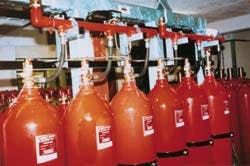

(Left) Hygood can supply a range of firefighting systems, including these cylinders. (Right) Polygonal gridding used by EPS and Mincom to analyse well tests.
Known geological and seismic features could be added to the model to assist in interpretation of well test pressures, and every boundary condition conceivable could be incorporated to investigate probable reservoir descriptions and reconcile them to the test data. The aim is rapid testing of different scenarios to reduce simulation run times.
Another new development is a resource optimization product called ReO. This builds on EPS' FloSystem tool for inflow modeling and outflow calculations, and could lead to up to 5% more oil being extracted from reservoirs that would otherwise be abandoned.
A major feature of ReO will be its ability to store, manipulate and report on large quantities of measured production-related data within a POSC-compliant object database, enabling engineers to compare simulations simply with actual data.
The software is being evaluated at the Edinburgh Parallel Computing Centre, with funding for this A1 million development coming from various enterprise groups and oil companies. A first release for modeling gas production systems should be ready shortly.
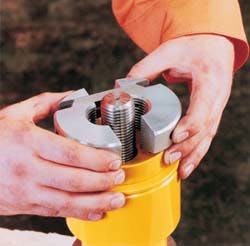
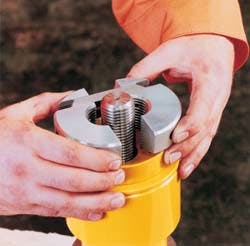
Bolt-tensioning specialist Hydra-Tight, based in Walsall, will feature a trio of products premiered this September at Offshore Europe. Amongst these is a split nut which reduces the strains divers suffer when making up subsea bolted assemblies that must be hydraulically bolt tensioned.
Normally, tensioning tool puller nuts have to be wound on, but Hydra-Tight's vertically split nut is in two halves which slide apart. The slide mechanism is located at one side of the nut only, leaving the opposite open so that the nut can be fitted and positioned onto a bolt or threaded bar in the required position.
No time is wasted running the nut up or down and it can easily be fitted to bolts where there is little over bolt space available. The split nut can also bypass damaged threads that would jam standard nuts: when fitted directly to a damaged thread, the nut can also reform the bolt thread.
With the nut's conical underside locating in a conical seat on the tensioner tool (angles of which are the same as the bolt threads), all forces are directed centrally. This effectively locks the split nut to the bolt once the tool is pressurized. Hydra-Tight claims this system can save divers a minute or more per bolt (of which there can be quite a large number on a typical flange).
The company has been represented for years in Jakarta by Pupma. This agent now carries comprehensive stocks of Hydra-Tight's bolt tensioners and portable machinery for on site, in situ machining. An ex-Hydra-Tight employee, Richard Bray, has also just been taken on by Pupma to oversee local execution of the company's contracts.
Positive Metering Systems (PMS), based near London, is a designer and constructor of chemical injection and dosing packages for the oil and gas industry. A key product for the offshore sector is the Multipoint chemical metering and distribution valve system for manual or remote control, used typically for scale/corrosion inhibitor injection on topsides and subsea applications.
Through employing just one positive displacement pump as a prime mover, this unique, multi-orifice flow control valve system eliminates the need for multi-head proportioning pumps and associated high pressure pipework. According to PMS, the main advantages of this configuration are space, weight and, consequently, cost savings. There are reportedly no system leaks and no need for scheduled maintenance, with reliable repeatability at low flow rates.
After four successful years in service at various BP and Arco-operated sites in Alaska, these systems were then introduced to the North Sea: BP, Statoil, British Gas and Maersk Olie and Gas now have a number of systems permanently installed.
PMS has presented the system to several other oil companies in Norway, Scotland and the Middle East. A working unit will be demonstrated at the Jakarta exhibition that will incorporate a two point injection unit.
PMS also designs and supplies gas-driven/controlled chemical injection units. These are typically used on remote wellhead platforms in the Middle East. To date 26 units have been supplied to one major oil company, all of which are working satisfactorily. PMS is also looking to establish sales contacts in Indonesia and the Far East in general, as well as forming joint ventures with companies that have a quality fabrication facility.
Currently negotiating for representation in Jakarta through agent P.T.Oaktech Nusantara is firefighting systems designer and manufacturer Hygood, based in Guildford, UK.
In Jakarta next month, the company will be showing for the first time in Indonesia new electronic equipment which constantly monitors the readiness for action of fixed extinguishing system cylinders. The Watchman accurately supervises the weight of each cylinder to warn of leakage.
Should weight loss be greater than is permitted on the installation for safety, Watchman will activate an alarm on the affected cylinder. This alarm can also be relayed to a remote monitoring station, alerting the installation supervisors who might otherwise remain ignorant of the hazard until their next annual inspection test.
Watchman is modular, so it can be expanded to fit most firefighting systems, and it can also be retrofitted to existing gaseous fire extinguishing installations, according to Hygood. Each Watchman incorporates a sturdy steel platform base, measuring around 300 sq mm, and only requires a local power supply.
Hygood is selling the system with its zero ozone depleting FM200 gaseous extinguishing system, which the company claims is the only replacement for Halon 1301 in Britain to gain approval both from Lloyd's Register and the Loss Prevention Council.
The Hygood FM200 fire suppressant will also be shown in Jakarta for the first time. FM200, produced by Great Lakes Chemical Corp. in Indiana, USA, can be used safely in areas containing electrical, communications and data processing equipment, plant or machinery. It is cleared quickly by natural ventilation, and is claimed to require much less storage space than CO2 or inert gas systems.
According to Hygood managing director Tim Goodman: "FM200 could be an exciting system for the Indonesian oil industry, as their safety officers are looking for replacements for 1301 systems". To accompany firefighting equipment for aggressive offshore environments, Hygood can also supply cabinets and enclosures in stainless or galvanized steel, with offshore-standard paint finish. Equipment can also be skid-mounted to ease craning on and off an installation.
Copyright 1995 Offshore. All Rights Reserved.