The Middle East, new super-majors, and more industry consolidation
PART I: This is the first article in a three-part series on strategic issues affecting the global hydrocarbon industry - an analysis developed following interviews with 70 major industry executives. Parts II and III will appear in following issues.
The rapid swirl of events today is such that it is difficult for a professional working in the hydrocarbon market to get bearings. Old rules of thumb and old guideposts seem obsolete and everyone is put off balance. Senior hydrocarbon executives are trying hard to exert leadership, while facing the conundrum of how best to prepare for a constantly shifting and seemingly unknowable future.
The only recourse for senior managers wishing to better understand their changing world is to identify and think through the consequences of emerging key issues and forces reshaping, or having the potential to reshape, the hydrocarbon industry and service industries that serve it.
What are the important issues and factors worthy of consideration? As management consultants trying to better understand the emerging New World, we have suggestions on which factors, forces, and issues merit the attention of senior hydrocarbon executives:
- Producer country (Middle East) and super-major alliances
- Growing role of intellectual capital to the energy industries
- Reasons behind the movement toward consolidation
- "New" economics of the oil patch
- Global economics and the dollar.
THE MIDEAST AND SUPER-MAJORS
Major oil companies are always seeking new inventive strategies that can produce a sustainable competitive advantage. What if a large super-major decided to pursue a strategy of alliance with a low cost producer country such as Saudi Arabia, instead of directly competing with them? Would this not create a tremendous strategic advantage? What would be the consequences of such an alliance on industry strategy and structure?
Recent high level private meetings between top Saudi officials and oil company chieftains provide intriguing hints that such a union might be in the offing. Let's review some reasons why a union between the right kind of low cost producer and a super major oil company might make good business and political sense.
In recent years, Saudi Arabia watched its dominant worldwide market share of crude exports decline sharply from 17% to only 12%. It also witnessed Venezuela pass it by to become the dominant player in US oil imports. Given, Saudi Arabia's geopolitical situation and need for American military support, this loss of influence is a discomforting state of affairs.
The Saudi government is also uneasy about its internal political situation and an exploding population growth of 3.4%, one of the most rapid in the world. To shore up domestic needs, Saudi is borrowing heavily from financial markets - its domestic debt almost equals its GNP - and courting indebtedness. Saudi Arabia, therefore, would undoubtedly prefer circumstances assuring less cyclical and more certain cash flow to meet its societal needs.
Alliance advantages
Other potential advantages of such a union or alliance include:
- More return: Partnership with a producer country assures a super-major of being the lowest cost producer. Finding and development costs in Saudi Arabia are well below $2/bbl, creating a major competitive advantage. A super-major gets a lot more for the investment buck by drilling and producing in the Middle East. There is another way to view things. The capital cost of producing a bbl of heavy Venezuela crude is about $28,000 (per bbl of daily production). In comparison, the most expensive oil to produce in Saudi Arabia is from the Shaybah field. It costs $5,000/bbl (daily production) in capital investment to produce.
- Minimize technology: Since Saudi oil and gas are cheap to produce, one has less need for carrying high cost technical staff. Furthermore, drilling and production are relatively straightforward. This lessens the need for high cost E&P technology from outside suppliers.
- Financial strength: Any alliance that provides an equity stake in a producer country's oil and gas properties dramatically increases proven reserves, while significantly lowering average finding and development costs. Consequently, this would result in a significant improvement in the P/E ratio and financial strength. The resulting higher P/E ratio also allows an oil company to use its lofty priced stock to more easily buy up other weaker, but interesting, petroleum firms. This situation would be very similar to what is happening with the life science chemical firms.
- Beat back independents: Finally, this type strategic alliance would drive a stake through the hearts of many petroleum independents. Using the new technologies, such as 3D seismic and horizontal drilling, the independents have been formidable competitors. However, with access to very low cost crude, a super-major could drive out of business many independent producers.
Financial commitment
Any alliance with a producer country assumes the capability to make a huge long term financial commitment - well over $100 billion in a single decade. Thus, such an arrangement assumes the existence of a super major(s) capable and willing to put a majority of their capital expenditures in a producer country. The advent of such a strategic union would quicken the trend toward consolidation.
The ensuing industry-wide consolidation would also trigger the defensive creation of at least two or three "new" super-majors willing and able to form unions with producer countries such as Iran, Iraq, and Kuwait. In time, the trend would spell the demise of most independents.
Finally, a potential union might start modestly as a simple arrangement to develop producer country natural gas and power projects, but grow into a full blown hydrocarbon partnership. Producer-super major alliances could revolutionize and transform the industry.
Other consequences
Super major-producer country partnerships also imply important and complex consequences for other parts of the hydrocarbon industry. These consequences merit careful reflection. For example, in a world dominated by super-major alliances, there will likely be smaller exploration and production (E&P) budgets, but a strong need for very large technical service and equipment companies to complete multi-year mega-projects (such as a major increase in Saudi crude production).
These projects will be technically straightforward, but require enormous financial and human resources. Consequentially, if these alliances do occur, there will be less need for the advanced type technologies pioneered by some of the largest service companies today, but more need for companies capable of executing large-scale routine work inexpensively. The trend toward consolidation in the service industries would likely further accelerate.
INTELLECTUAL CAPITAL'S ROLE
The business journal Forbes provides an annual list of the 400 wealth iest Americans. In 1998, the list included 43 new entrants. Only two of them made their fortunes by creating hard asset type enterprises. The rest earned entry onto the list by developing businesses powered by know ledge or intellectual capital (patents, software, services, for example).
This is in sharp contrast to a decade earlier, when 30% of the new Forbes entrants on the list came from hard asset businesses such as manufacturing and real estate. The business world is changing profoundly. New wealth is increasingly emerging from the intangible world of ideas and concepts.
For example, Microsoft is the most valuable company in the world. It has a market capitalization of over $400 billion, but only $20 billion of hard assets, in the form of cash, buildings, and equipment. The real value of Microsoft is in intellectual capital and knowledge, and not in buildings and factories.
What exactly is intellectual capital? How can you define it and measure it? Of what possible interest is such a subject to executives inhabiting the hydrocarbon world? Intellectual capital is defined as knowledge in the form of name brands, reputation, customer relationships, proprietary technology, organizational systems and unique configurations of professional skills. It is the stuff comprising goodwill.
Shrewdly applying intellectual capital to work creates significant value. This is the reason behind the drive by many oil and chemical companies to acquire and implement expensive advanced information systems like SAP and Baan. It is the driving force behind the creation of e-commerce companies. These systems allow them to monetize their intellectual capital.
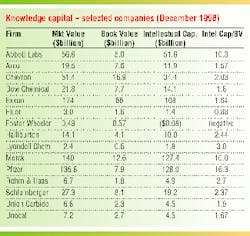
By its nature, knowledge capital is hard to measure. However, an imperfect but useful indicator is the difference between a firm's market capitalization and book value. This calculation provides a surrogate for intellectual capital that can be refined further by adjustments, if necessary.
Can't measure this capital
Intellectual capital (IC) is not specifically time-related. For example, it is unlike a machine tool that one must pay to use by the hour or day. Knowledge is valuable in and of itself and not necessarily measurable in time increments. If a company or industry is to prosper, it is increasingly necessary to incorporate knowledge or intellectual capital.
Failure to do so means that the company or industry will decline in relative value and leadership. It will become an also-ran commodity industry. This makes attracting new capital and human talent difficult.
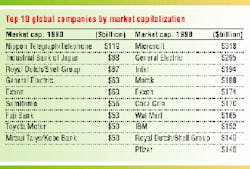
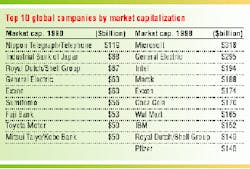
Many of the top firms in 1990 were Japanese and did not develop their intellectual capital base. They lost ground. Conversely, a conglomerate like General Electric did progress by
developing intellectual capital through their subsidiary, GE Finance. If a company or industry does not develop intellectual capital, it soon loses favor with the investment community.
How have the companies inhabiting the hydrocarbon industry - petroleum, petrochemical, chemical, petroleum service, engineering contractors - fared in developing or growing their intellectual capital base? From the authors inquiry, the results appear very mixed.
The major petroleum companies have added a little to their intellectual capital stock in recent years by somewhat disinvesting in tangible assets and investing heavily in information software to enhance their productive capabilities. A number of chemical firms such as Hoescht, Rhone-Poulenc, and Monsanto are greatly enhancing their market value and knowledge base by investing heavily in agricultural and biochemicals. Biologically-oriented chemical firms are doing very well in building their knowledge base and market value.
Where are service firms?
There is more disparity of performance among the technical service firms. Some such as Schlumberger and Halliburton, a recent purchaser of Landmark, added significant intellectual capital and were rewarded with above average market valuations.
Unfortunately, most of the engineering contractors are still trying to find a way to incorporate intellectual capital. However, none have yet devised a way to add knowledge capital to their operations, and thus find themselves viewed by the investment community as mere purveyors of commodity products and services. It is crucially important that the top managers of engineering contractor firms invent a way in the future to incorporate a higher portion of intellectual capital in their companies. To do less is to assure a bleak future of low profits as a backwater industry.
The ratio of intellectual capital to book value shows the overall importance of intangible assets to the company and also the firm's perceived worth in the market. Pfizer, for example, has a high ratio of intellectual capital to book value - 16.3 - and has less than $8 billion of hard assets supporting a market capitalization of $136.8 billion.
Contrast Pfizer with Dow Chemical, which has about the same amount of hard assets, but only a relatively feeble market capitalization of $21.8 billion, because of its dearth of knowledge capital. Assimilation of a high degree of intellectual capital is crucial to future success for all firms.
Industry status
To sum up, there is strong evidence that industries and firms capable of adding relevant knowledge capital have higher valuations and better financial returns. It is equally clear that a number of industries and firms are finding it difficult to raise productivity by incorporating ideas and concepts that augment their intellectual capital pool. The situation can be described as follows:
- Ratios below two: The major petroleum companies, through divestments, restructuring, and enhanced use of information technology, are raising their intellectual capital quotient. However, most oil companies still have intellectual capital to book values below two. This is unsatisfactory. Petroleum strategists will have to work hard to raise their firm's knowledge bases. Failure to do so will make it impossible to attract first class talent and a sufficient quantity of capital to succeed.
- Other industries: Some of the major chemical companies are abandoning their traditional basic products to enter the know ledge-rich biochemical industry. These firms are being rewarded with very high share prices by the investment community.
- More integration: The petroleum service companies will continue to consolidate and integrate equipment and services in packages that are attractive to the new client markets. These actions will enhance the intellectual capital pool of these companies enhancing their value and reputation with the investment community. Halliburton merging with Landmark and Dresser and revamping their engineering divisions is a sign of the times. The same is true of Baker Hughes purchase of Western Atlas and Schlumberger's acquiring Camco. This industry will require continuing increases in size and the melding of disparate pieces to build up significant intellectual capital and long-term success.
- Search for value: Engineering contractor firms are having a difficult time trying to incorporate intellectual capital into their operations and enhance financial results. Bold new strategic concepts need to be developed for the industry by its strategists - such as concepts that add knowledge capital. A mixture of engineering contractor assets with equipment products and services, as is being pioneered by ABB and Halliburton-Dresser, may prove to be the answer. Engineering contractors need more and better strategic thinking at the top to develop new concepts that add value to an industry that is increasingly viewed as a provider of a commodity.
Advantages of strategic union between low-cost producer country and super-major
ADVANTAGES TO PRODUCER COUNTRY
- Solidifies political support with the home country of the super-major. This is, in most cases, the United States.
- Provides increased and assured finances for upstream and downstream projects. The super-major can then act as a surrogate to increase their market share. For example, Saudi Arabia could easily increase crude production by 50%.
- Helps dry up non-OPEC energy supplies. Since the bulk of the super-major's E&P budget is spent in the producer country, it cuts spending in outside areas. Other copy-cat super-majors help drive many independents into bankruptcy. Investment is further concentrated within OPEC and non-OPEC crude supplies are diminished.
- Provides the financial and technical resources to develop substantial natural gas reserves.
- Provides a steadier stream of cash flow and allows better control of energy pricing. This is crucial to fostering political stability at home.
ADVANTAGES TO SUPER-MAJOR
- A low-cost supply of crude and natural gas allows them to cut E&P budgets and depend less on expensive technical staff and advanced E&P technology.
- Concentration of investment in producer country yields efficiencies. Cheap oil supplies are a competitive advantage against other majors.
- Low cost strategic posture provides a competitive advantage against independents. This weapon would drive many independents into bankruptcy.
Note: Transmar Consult Inc. is a Houston-based consultancy.