Increased rig activity may improve drillers' 2Q performance
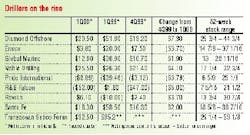
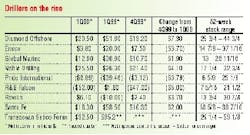
Whether it's a high but stable oil price or some other factor, activity in the rig market is definitely on the rise. Almost every stock in the drilling sector has achieved a 52-week high in the past few months, returning drilling company valuations near levels two year's ago.
This stock increase comes even as drillers post sharp declines in first quarter 2000 earnings from 1Q- 1999 levels. But, while they are lower than 1Q-1999, almost all have beaten earnings posted in the final quarter of 1999. This shows a gradual increase in results and the stock prices have reciprocated. This increase has also been across the board. Almost every company, regardless of whether they are positioned heavily in the stable deepwater or hard-hit jackup market.
So how far off are the drillers from reporting an increase in earnings? It could be as close to next quarter - assuming the oil price remains relatively stable. The reason is that while drillers are still down in the earnings game, the operators are posting record earnings, and Shell posting the "best earnings in history." The operators earnings show a direct correlation with the oil price: when oil is high, they make money, and vice versa.
The drillers, however, are once removed from the oil price. They must wait on the operators to make the first move, and with record earnings, the operators are beginning to move. Money should begin to trickle down into the drillers' pockets. This is evidenced by a number of new contracts received on rigs of late. Almost every company has reported an increase in contracts on their existing fleet. While these contracts still show a lower day rate than a few years back, it does show an improvement from a few months back, when no contracts were awarded.
Two drillers race for deep shallow water
The race is indeed on for the title of leader in the market niche known as the deepwater jackup. Two companies - Rowan Drilling and Chiles Offshore - have been vying for this role for some time and have been building rigs despite the lack of firm contracts. Target formations include very deep reserves, frequently subsalt, and high pressure/high temperature regions where fixed rigs have an advantage.
The first contender is Bill Chiles of Chiles Offshore. Chiles has entered into an agreement with Keppel FELS of Singapore to build a KFELS MOD V "B" design, cantilevered jackup. The rig design is a proprietary design owned by Keppel, modeled after the MOD V design, but modified for non-harsh environment usage. The rig will be an "ultra-premium" deepwater jackup built to a leg length of 475 ft, with an option to extend it to 545 ft. Chiles said, "the new rig will embrace digital technology and state-of-the-art information and communication systems."
This new jackup will be Chiles third ultra-premium deepwater jackup. The company recently took delivery of two other jackups built by Amfels in Brownsville, Texas - the Chiles Columbus and Chiles Magellan. The company recently bareboat chartered the Tonala from Perforadora Central of Mexico. The new rig is expected to cost $110 million and be delivered in the second quarter of 2002.
While Chiles is going deep, the leading contender, Rowan Drilling, is going deeper. Rowan has committed for the design and construction of the Gorilla VIII, an enhanced version of the company's Super Gorilla Class rigs and designated as the Super Gorilla XL.
The Gorilla VIII will be outfitted with 708 ft of leg, 134 ft more than the Super Gorillas, and have 30% larger spud cans for working in up to 550 ft in the Gulf of Mexico (near the edge of the shelf). The rig will also be capable of harsh environment operation in water depths up to 400 ft, making it the jackup with the deepest capability.
The cost of the rig is estimated at $190 million and will be built at Rowan's Vicksburg, Mississippi yard with delivery in the third quarter of 2003. In addition, Rowan has received contracts with PanCanadian Petroleum for the Gorilla III and Super Gorilla V jackups. The rigs will be used off eastern Canada for abandonment of the Cohasset and Panuke Fields near Sable Island and for exploratory drilling. The contracts will provide as much as 12 rig months of work.
Three new deepwater semis hit the water
More of the new ultra-deepwater rig fleet is on its way to operation. Recently, contractors held christening ceremonies on three new semisubmersibles rigs and they will begin shortly spudding their first wells.
- R&B Falcon has delivered the first of the
RBS-8 design fifth generation semis. The Deepwater Nautilus is a moored semi capable of operations in the Gulf of Mexico and West of Shetlands in water depths up to 8,000 ft. Shell holds the initial contract for the rig for work in the Gulf of Mexico. It has been rumored that the rig will drill in a record 8,400 ft water depths using a new, specialized mooring system, despite its 8,000 ft depth capacity.
- Pride International and partner Maritima of Brazil are sending their first two of four Amethyst-design semis down to Brazil for contracts with Petrobras. The rigs named the Pride Carlos Walter and Pride Brazil are both dynamically positioned four-column semis capable of operation in up to 5,000 ft water depths. The rigs also feature a unique aspect - vertical pipe storage in the columns. Overall cost for each rig was approximately $170 million and both were built at the Daewoo Heavy Industries yard in South Korea in a record 13 months. The companies have two more identical rigs under construction at the Friede Goldman Halter yard in Pascagoula, Mississippi.
CORRECTION: In the April issue, Offshore mistakenly reported the cost of Tidewater's new-build program as $4.3 billion. The actual program cost is estimated between $250 and $300 million.