Stud solution aids mooring chain performance
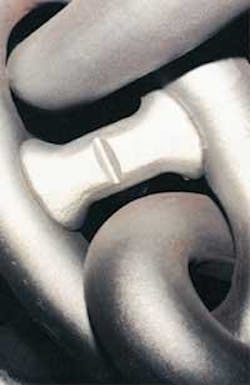
Studlink or studless? According to chain- maker Ramnäs Bruk, this remains a key question to address when specifying mooring systems for floating production units and mobile drilling rigs. In the past, concerns over studlink chain have led many customers to opt for studless. However, different manufacturing techniques, backed by positive feedback on the long-term performance of studlink chain, indicate that the problems of studlink have been overcome. Now the company feels it is time for customers to re-appraise the situation.
Studlink offers numerous benefits over studless chain, including a longer fatigue life. During the 1990s, however, confidence in studlink chain was undermined by surveys showing that a significant number of studs were working loose. Data collected by Chainco of Norway found that two of the five major offshore chain manufacturers surveyed presented an incidence of more than 70% of loose studs. For Ramnäs the figure was 17%. The results were worrisome, as a loose stud can cause tension in the weld area of the link, with a consequent reduction in the link’s fatigue life. Repairs can be costly.
Welding the stud in position is not the answer, as this leads to a number of drawbacks, and the grade R4 steel from which the bulk of Ramnäs offshore chain is made cannot be welded. Instead the company developed a dual solution involving the use of asymmetric studs fixed in place by a process of controlled stud expansion.
To enhance the link’s fatigue life, the stud must have an equal footprint on each side of the link, explains Olle Wandin, an engineer in the production department. However, as the stud is installed shortly after the ends of the link have been welded together, equal footprints are not achieved when using a symmetric stud due to the temperature difference on either side of the link. The necessary corrective action is provided through use of a correctly dimensioned asymmetric stud.
At the same time, the stud can be fixed in place by a process of controlled stud expansion. The stud is expanded by nipping it in the middle. Only a small controlled expansion is required, since excessive expansion would create stress in the link.
Troll B feedback
Feedback indicates that this dual technique, which is unique to Ramnäs, overcomes the problem of loose studs. In a study of 45,000 links of 3-in. grade R4 chain which had been in service for five years, only 0.25% of studs were found to have come loose. And an inspection carried out last year by Norsk Hydro on the 6-in. grade R4 studded chain used to moor the Troll B production floater in the Norwegian sector found no loose studs. This chain was delivered in 1994.
“We’d like other customers with studlink chain to provide feedback,” says marketing manager Anders Berg. “We know of some who have done inspections with an ROV, but often they’re only checking for wear on the chain.” Studlink chain costs more, but the additional cost is a worthwhile investment to achieve longer life, he claims. In his opinion, studlink chain has numerous other advantages over studless, including:
* Higher proof load
* Increased fatigue life
* Reduced risk of stress corrosion in the weld
* Improved utilization of the base material ductility
* Increased peak loads without any deformation
* Easy installation, with no kinks or knots.
For more information, contact Anders Berg, Ramnäs Bruk. Tel +46 220 220 24, fax +46 220 358 37, [email protected], www.ramnas.com.
New lease on life
Ramnäs, which began operations in 1590, was acquired last year by a consortium of investment group Svensk Rekonstruktionskapital, which now has 60% of the shares, and Arvid Svensson, a private company.
Since then, Ramnäs has continued to add to its reference list. Its latest order, from Technip Offshore, is for 1,345 tons of 108-mm and 114-mm mooring chain for theDaliaFPSO in Angola. “This order is very important for us,” says managing director Carina Andersson, explaining that it is the first Ramnäs has won from this contractor for many years. Dalia’s operator, Total, imposes stringent requirements, notably in documentation, she says.
Ramnäs is also represented in Excelerate Energy’s Gulf Gateway Energy Bridge, the world’s first offshore regasification plant, which has been installed in the Gulf of Mexico as a receiving terminal for liquefied natural gas imports into the US. Here Ramnäs supplied 1,600 tons of 134 mm, grade R4, studless chain to moor an APL submerged turret-loading system.
Among its deliveries last year were two orders for Bluewater. One was 350 tons of 81-mm, R3S grade chain to moor a CALM buoy as part of Statoil’s South Pars phases 6-8 development, and the second 138 tons of 3-in. chain for mooring a CALM buoy off Ecuador. The latter was a rush order, Andersson says - it was received in November, and the chain delivered in December.
Early this year the company, which recently gained ISO 9001:2000 certification, was manufacturing 506 tons of 3-in. R4 chain for Stena Drilling’sStena Dee drilling semisubmersible.