Independent operator poised for major role
W&T Offshore continues GoM expansion
Jaime Kammerzell, Gulf of Mexico Editor
Independent operator W&T Offshore has made headlines lately with its move from a private entity to a publicly held company. Prior to this, W&T Offshore flew under the radar, adhering to its policy of no advertising or press releases.
With this shift, W&T Offshore is poised to grow from a billion-dollar private firm to a multi-billion dollar public company. Going to the capital markets has made this possible. W&T feels it is more competitive now that it is publicly held.
W&T Offshore has progressed steadily offshore during the past 22 years, moving from marsh to shallow water, then to deepwater, not to mention the deep shelf. A good number of W&T’s wells are in the 600-800 ft water range, but it does have some deepwater wells. For example, the company’s Daniel Boone prospect is in 4,200 ft of water. Now that the company has access to capital, the industry may see W&T in even deeper waters.
“We like to control our own destiny and operate with or without partners, as required,” Manuel Mondragon, assistant treasurer, W&T Offshore, says.
This philosophy has served W&T well. One of W&T’s biggest events was the purchase of the Columbia Gas Development Co. in spring 1996, which W&T renamed AVIARA. This acquisition made W&T a 50-50 partner with Hunt Petroleum Co. A year later, Hunt bought out W&T’s interest. Mondragon sees this as “the Big Bang event” for the company, because the sale allowed W&T to pay off debt on producing properties. The retirement of debt enabled the company to move forward with a reduced burden and a healthy cash flow.
W&T started string of acquisitions with its purchase of Vastar in 1999. In 2000, it bought properties from BP Amoco and EEX. In 2002 and 2003, the company grew appreciably with the purchase of significant properties from Burlington Resources and ConocoPhilips.
“Over the years we bought these properties - mostly producing - and built the company up to get production and grow some scale, Mondragon says. “We ended up turning these properties and fields into significant acquisitions. They’ve become home runs for us.”
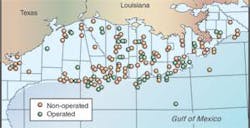
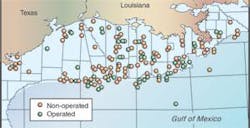
W&T operates solely in the GoM. Its 2005 drilling plan includes five development wells and 30 exploratory wells. Of these, six wells are in deepwater, four are on the deep shelf, and 25 are on the conventional shelf. The company also had nine of 15 successful high bids in the most recent GoM lease sale.
“W&T’s goal is to become the premiere GoM E&P player,” Tracy Krohn, founder, chairman, president, CEO, and treasurer, says.
The Gulf is a very capital-intensive place, which is why W&T went public. As the company has grown, it took on bigger projects.
“I simply want the company positioned so that we can do these bigger projects without taking ‘company bets,’” Krohn says. “I’ve seen some projects that I thought were worthy of our attention and something we could certainly accomplish, but it would put us in a position of having to bet the company on one thing, and I don’t think that is wise.”
Krohn has been through several different cycles in the GoM.
“Whenever I hear the Gulf is dead, I think there must be a lot of opportunity left.”
He has proved that you can grow to a multi-billion dollar company just by staying in the GoM.
“We are a fairly large acreage holder. A majority of our acreage, in excess of 80%, is held by production. So we have a lot of exploitation and exploration to do on our own acreage, which will carry us a long way into the future.”
W&T has over 1 million gross acres in deep and shallow waters, and it believes there are deep shelf opportunities there somewhere. But deep shelf formations are difficult to identify because the current technology has difficulty reading 20,000 ft below the surface.
“We are able to identify the structure, but the hydrocarbon indicators are more difficult to identify,” Krohn says. “It is like wildcatting 20-30 years ago.”
What also has contributed to the independent’s success in the GoM is the exploitation of harder-to-reach hydrocarbons. As Mondragon says, majors need huge finds on big fields to make an impact to their bottom line. A smaller company like W&T can dedicate an engineer to one block on that field and exploit it to truly affect the company’s results.
“Once the easy stuff is identified and exploited, the true exploration will be next, and that is where our guys dig in,” Mondragon says.
The GoM is very capital intensive, but it also generates a great deal of cash.
“We’ve been very successful in the GoM,” Krohn says, “and I like cash. So if we find something that is profitable, we will go do it.”
Krohn thinks W&T can capitalize on its GoM properties, but he is not opposed to operating onshore.
“If we do find something onshore that I thought was worthy of that kind of risk, we would certainly do it. It is not a philosophical thing; it is a profitability thing. So if we find something that is profitable, we will go do it.”
Krohn believes that if a company can successfully drill a well and produce it in the deepwater or deep shelf GoM, it can succeed anywhere.
The difference, he says, between onshore and offshore is “onshore is more of a manufacturing operation, and offshore is more of an exploration/exploitation operation.”
The GoM also takes more dollars to operate, the reserves tend to be larger, and cash comes back to the company quickly. The trick is to continue to re-deploy the capital.

“We generate tremendous amounts of dollars per well, and that’s what we like. Our prospects going forward in the GoM - where we have large acreage holdings and have a lot of experience - is a profoundly good position to be in.”
W&T’s experienced drilling engineers have served the company well. Most gained deepwater experience with a major and then took that experience to W&T Offshore.
“I think when you surround yourself with intelligent, hard working people, good things happen,” Krohn says. “So I look for a lot more good things to happen and the company to be extremely profitable going forward.”