Pemex struggles to keep up output
Mexican government shelves industry reforms
David Shields
Mexico correspondent
Petroleos Mexicanos is spending more E&P dollars in an effort to increase domestic production, but critics insist that the investment falls short of what the country needs.
Pemex’s current investment budget is about $10 billion annually, with $8 billion going to oil production, $1 billion to exploration and $1 billion to refining, gas processing, and petrochemicals.
Foreign companies are cashing in on drilling, service, and supply contracts resulting from increased exploration spending, but Mexico is not seeing a significant benefit from its increased investment. Production numbers are not going up.
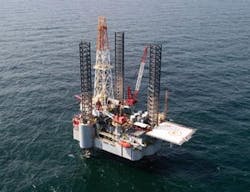
Increased E&P spending has made contract work an increasingly attractive prospect, with good day rates being applied to long-term contracts. Independent leg jackups are paid $50-60,000/day, while semisubmersibles fetch $70-80,000/day. Pemex is paying a premium of almost 10% compared to the US Gulf, and activity is picking up. The company foresees growing activity on its offshore Ixtal-Manik, Kanaab, Tabasco Littoral, and Ku-Maloob-Zaap projects in the coming months.
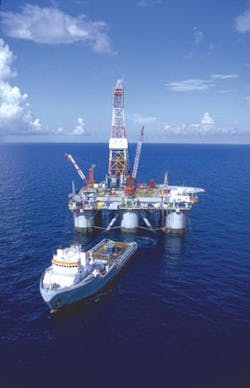
The mobile offshore drilling unit market in the Mexican Gulf has almost tripled over the last three years, with 55 rigs (27 jackups, 11 semisubmersibles, 13 platform rigs, three inland barges, and a drillship) working in Mexican waters, according to a July count.
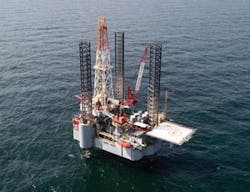
US-based companies dominate the business. Pride International has been the most successful contractor in recent years, with 14 jackups, a semi, and three platform rigs currently working for Pemex. Other major players include Noble Drilling, with eight jackups, Nabors Offshore, with five platform rigs and a jackup, Diamond Offshore, with four semis, and Todco, with two jackups and a platform rig.
Another successful Pemex initiative has been its offshore platform building program, which has Mexican construction yards overflowing with work.
Three years ago, Pemex announced its intention to tender 48 new offshore platforms, of which 30 have now been awarded. Although Mexican companies, such as Commsa, Swecomex, and Bosnor, have led the way, some of the business has gone abroad. California-based Flour Daniel has a major participation in six of the contracts through its partnership with Empresas ICA, Mexico’s biggest construction firm. The six ICA Fluor Daniel contracts together are worth over $200 million.
Singapore-based Keppel SLP heads a consortium that won a $164-million contract to build two accommodation platforms on the Ku-Maloob-Zaap complex. The consortium includes Louisiana-based Gulf Island LLC, which will make the jackets, piles, and deck-leg modules on the platforms. A similar contract for living quarters on Ku-Maloob-Zaap went to Berry Contracting, for $149 million.
Ku-Maloob-Zaap is Pemex’s major offshore oil project after supergiant Cantarell. Pemex is vigorously increasing infrastructure on this offshore complex in Campeche Bay, which lies in shallow water 50 mi northeast of the city of Ciudad del Carmen.
Building production platforms on this complex is a lucrative business. One such platform went to Spain’s Dragados for $185 million and another $225-million contract went to Swecomex, part of Mexico’s Grupo Carso industrial conglomerate.
Meanwhile, Global Offshore Mexico, a wholly-owned subsidiary of Louisiana-based Global Industries Ltd., announced several subsea pipeline contracts from Pemex.
One contract is for four pipelines in the Ku-Maloob-Zaap field, and another is for three pipelines in the Yum field. The Ku-Maloob-Zaap contract is worth $53 million, and the Yum contract is worth $26 million.
Government reforms
Despite awards to foreign drilling contractors and service companies, Mexico is highly unlikely to involve foreign operators in its offshore.
It is now clear to all industry observers that there is no political will, particularly in Mexico’s congress, to make oil industry reforms that would allow direct private investment in E&P anytime soon. Major reform proposals, such as those relating to Mexican Gulf of Mexico deepwater development, have been shelved and are unlikely to be discussed or reviewed in the upcoming election year.
Mexican law continues to prohibit awarding concessions to private operators as well as any kind of joint ventures between state-run Pemex and international majors that might imply sharing investments, reserves, output, or profits. Reform proposals are not likely to be taken up again until 2007, when a new government will be in power.
Until then, Pemex will be in a “business as usual” mode, facing the challenge of maintaining crude oil output around current levels in the face of incipient decline of its supergiant Cantarell oilfield.
Some government and Pemex officials have, nevertheless, been calling for reforms and for greater investment in Mexico’s oil industry. They say a joint venture between Pemex and international majors is required to develop deepwater oil fields shared with the US, particularly in the Perdido fold belt.
Majors are already at work on the US side of the maritime boundary, and officials say that a joint binational strategy is required in order to develop these crossborder fields optimally.
“We are not being pressured by the majors, but by ourselves, because now is the time to develop these fields,” Carlos Morales, head of Pemex’s E&P division, says.
“We believe that if the Mexican oil industry were to find ways of investing $15 billion annually, especially in deepwater, we could have a world-class industry that could produce 6 MMb/d or more at some future time. However, this would imply legal changes and new forms of association that are legally off limits at this point,” Morales says. Mexico produced 3.38 MMb/d last year.
Several international majors have publicly poured cold water on the idea that they might get involved in deepwater ventures with Pemex at this time in what could be interpreted as a message to Mexican politicians who seem unwilling to discuss the issue. In particular, the majors have said they will not be working with Pemex through some kind of broad services contracts geared to deepwater.
According to Tim Cejka, president of ExxonMobil’s exploration unit, who spoke at a high profile conference in Mexico earlier this year, “Service contracts do not recognize the high cost and high risk of deepwater and so don’t really provide us with the framework to do that.”
Cejka said the “case is compelling” for Mexico to invest $50 billion in exploration and $200 billion in field development over the next 10 years.
Opening doors to such investment could bring an accumulated increase of $650 billion in Mexican GDP, with perhaps another $400 billion in indirect income, equivalent to a 3% or greater increase in GDP, Cejka said.
According to Pemex CEO Luis Ramirez Corzo, Mexico’s oil industry requires investments of over $20 billion annually, twice as much as currently is being made. That amount, however, cannot be met with more debt or with the company’s budget. The industry thus requires what Corzo calls, “an intelligent, timely and efficient” opening to private investment.
Top energy ministry officials have said that Pemex will have to invest between $15 billion and $25 billion just in E&P in future years if it is to replace reserves and have a growth-oriented future.
Cantarell challenge
Pemex has set a production goal of 3.44 MMb/d for 2005. Output for the first half of the year averaged 3.37 MMb/d, down 0.9% year-on-year, but picked up to 3.43 MMb/d in 2Q. Offshore output for the first half averaged 2.8 MMb/d, also marginally down year-on-year. “This will be a year of construction and consolidation, rather than of increasing output. We hope to capitalize on current construction programs of offshore platforms, pipelines, and other infrastructure so that we can push up production in 2006,” Pemex’s Morales says.
A major issue going forward will be the performance of Cantarell, Mexico’s offshore supergiant field. Cantarell accounts for 62% of the nation’s total output and 74% of offshore output. A recent Pemex report says, “Pemex’s challenge is to maintain the production levels on Cantarell close to 2.0 MMb/d.” The report, meanwhile, acknowledges that output from the field is expected to fall from 2.08 MMb/d in 2Q of 2005 to 1.99 MMb/d in 2006, mainly due to well shut-ins. Cantarell output has already dropped by 64,000 b/d year-on-year, down from 2.14 MMb/d in 2Q 2004.
A decline in Cantarell output is a given in coming years, yet it remains to be seen just how fast the decline will happen. For some time now, Pemex officials and documents have referred to a likely long-term decline, which could pull Cantarell output down to about 1.0 MMb/d before the end of the decade. Pemex has produced 11 Bbbl from Cantarell over the past 25 years and expects to produce between 18 and 19 Bbbl from the field.
Cantarell’s decline could thus place a major restraint on Mexico’s ability to maintain or step up output in future years, especially since Pemex has been making very few relevant new discoveries. Mexico’s oil reserves have been falling sharply for years now, and in recent years, proven reserves of crude oil from new discoveries have been replacing only about 7% of the oil produced.
The magic political date of December 2006, when a new government will take office, may well be the key to understanding much of the current Pemex administration’s efforts. Pemex has been rushing to drill 53 new wells on Cantarell to ensure that there will be no major decline in output from the field before year end 2006. It seems likely Cantarell’s demise could be more pronounced after that.
Offsetting decline
Pemex says it expects that increased output from other offshore projects, particularly heavy crude from Ku-Maloob-Zaap and light crude from the Tabasco Littoral fields, will offset lower Cantarell output, with overall Mexican crude oil production increasing by 80,000 b/d next year.
In the long term, it is hoped these two projects will continue to offset decline in Cantarell, with output from Ku-Maloob-Zaap forecast to increase from its recent level of 300,000 b/d to 800,000 b/d in 2008, while Tabasco Littoral should provide 250,000 b/d of light crude in 2009, up from virtually zero at the beginning of 2005.
Meanwhile, Pemex announced the first deepwater discoveries, known as Nab, Numan, and Baksha, at over 2,000 ft in the not-so-deep Campeche Bay. These wells, drilled by Diamond Offshore as part of the Eastern Campeche project, are of 8-9 API crude, which means the wells will require secondary recovery techniques from the outset in order to produce at all. Obviously, it is not very marketable oil and does not yet appear to be a real option for replacing reserves.
Pemex has also moved to develop some other fields much farther north, though mostly in shallow water. One such field is Lankahuasa, Pemex’s promising dry gas province 10 km offshore from Nautla, Veracruz. Pemex has spent $300 million over the past three years to develop Lankahuasa, which is currently starting production and has estimated reserves of 2 tcf, including a nearby dry gas discovery known as Kosni. High resolution seismic studies identified 10-m-thick reservoir sands in Lankahuasa analogous to the Miocene-Pliocene producing plays in Texas. The initial well was drilled to a depth of 3,500 m in 60 m waters.
Pemex is committed to continuing development efforts, but its limited success to date indicates that the road to significantly increased production will be long and arduous.•