Drilling & Production
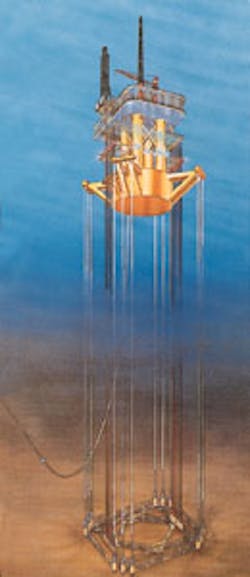
A mini-TLP with modular platform rig can significantly lower development costs of deepwater reservoirs.
Surprises are R&D bonus
For explorers and research scientists, finding one thing while looking for something else is an occupational hazard. Christopher Columbus was seeking a westward route to the east and ran into the Americas; Pasteur was researching distillation when he laid the groundwork for microbiology. So it was that Benton Baugh and colleagues at Radoil Tool came upon some surprising coiled tubing phenomena while working on a Deepstar contract to design a standardized test for wax and hydrate remediation systems in subsea flowlines.
For example, it has been assumed that straightened sections of coiled tubing do not reach yield when pushed through a 25-ft radius bend and therefore, theoretically, will straighten when the bending force is removed. But to the chagrin of Baugh and his colleagues, a test section of 1 1/4-in. coiled tubing did no such thing, remaining curved after bending forces were removed. The team of engineers has concluded since that when the bending forces were added to the coiled tubing's internal stresses, they exceeded yield.
A second poser concerned on coefficients of friction between CT and steel pipe. Because of its relatively small contributions to the essential elements of friction - diameter and weight - the movement of small-OD coiled tubing may be more hindered than helped by lubricants, especially viscous ones. Baugh found that as oil becomes colder and more viscous, it increases the sliding load on CT to the point it exceeds the effects of friction. That may in part, he believes, explain why some CT load prediction programs use a different coefficient of friction for each direction the pipe is moving when in the real world the coefficient of friction is independent of the materials' relative direction.
Implications of both findings are in how they effect the distance CT can be pushed or pulled. Residual bending from a piece pushed beyond yield when passed through a 25-ft radius bend in the pipeline, places a larger area of tubing against the pipe wall area. The result is higher buckling stresses sooner than predicted by a model assuming straightened CT.
And when the effect of fluid viscosity is three or four times that of friction, as was the case in the Radoil work, pipe loading will amass much more quickly, again initiating early buckling and shorten the distance the CT can be pushed.
Both previously unobserved (or at the least, unpublished) phenomena came as a surprise to Baugh's team because no one previously had been faced with just those circumstances. No one had thought to ask about the effects of viscosity on sliding loads, thinking only of friction. Likewise, the possibility straightened pipe might contain balanced stresses that can be pushed out of balance by the addition of a relatively small bending force and lead to yield just never came up in industry dialogues.
[Editor's note: As to progress on the original Radoil-Deepstar contract, see our paraffins report elsewhere in this issue.]
Miniplatform meets modular drilling rig
As semisubmersible dayrates continue their mercurial rise and the number of available MODUs fast approaches zero, the economics of some deepwater development plans may be at risk. The pay out from smaller reservoirs beyond 1,000-ft water depths are particularly vulnerable to six-figure dayrates and delayed rig schedules. So it is that a concept for a mini-TLP - originally designed as a production platform for fields with 50 to 150 million barrels of recoverable oil in 1,000- to 6,000-ft waters, 12 or fewer well bores, and more than 1,500 b/d production - is being mated with the modular platform rig concepts of the Nabors Industries subsidiary, Sundowner Offshore Services.
The mini-TLP is a product of MODEC called the MOSES (minimum offshore surface equipment structure) and is a beneficiary of work done by the Japan Ocean Industry Association and MODEC engineers whose final product is a single column mini-TLP tethered in 61-meters of water. MOSES is a four-column platform with a hull and tensioning system similar to that model.
While size and weight reductions are a key element of the mini-TLPs, their differences from the familiar full sized TLPs go beyond scale changes, most significantly in their riser and tendon placements, hull design, and lower-cost construction. Where larger TLPs bring risers from the seafloor to the center of the platform, mini-TLPs bring the risers along the outside perimeter of the platform, leaving the center of the deck open. Original rig-access plans included a horizontal shift of the tethered platform that would permit a floater to move in over the pre-drilled wells.
In the MODEC/Sundowner scenario, the available center deck space is used to lay down doubles of drill pipe, which rather than being racked into the tower would be skidded directly from laydown into the tower and into the hole.
The mast is based on Sundowner's 800 series minimum area, self-elevating (MASE) modular rigs. It is 135-ft tall with a million lb net hookload capacity, a split block top drive and 2,000 hp draw works. Since it does not hold pipe the mast can be lowered to the deck's center space for a lowered center of gravity in the event of severe storms.
MOSES main designer Pieter Wybro, who also holds its patents, said the Mini-TLP is field-ready and drawing the interest of major and independent Gulf of Mexico operators. Studies and bids are in to several potential clients and company officials expect to sell the first one soon.
Deepwater failsafe SSV
Even as the oil and gas industry meets the challenges of deep water, some operators are poised to raise the threshold yet again in ultradeep waters beyond 7,500 ft.
That is about the depth at which riserless drilling will be necessary to assure the final wellbore is of sufficient OD to produce at economic rates. It is also at about this point that the sea's ambient pressure is sufficient to overcome any practically-sized SSV failsafe actuator spring without pressure assistance.
The SSV dilemma is not news to valve manufacturers. At least two have designed failsafe valves to operate unassisted in ambient pressures of more than 4,500 psi - about the equivalent of a 10,000-ft column of 8.5 ppg seawater - only to see their offerings fail at the test level.
But one US-based valve manufacturer, Control Flow, has succeeded at the 10,000-ft level - and then some. Their 3 1/16-in., 15,000-psi working pressure failsafe SSV was tested without pressure assistance to an ambient pressure of 6,000 psi (about 13,500-ft water depth). The successful test was witnessed by Det norske Veritas at the end of January in the company's Houston test facility.
The secret, according to valve designer Larry Hadhazi, are seals (some proprietary) arranged so as to balance the ambient forces against the spring and neutralize their affects. Control Flow engineering manager, Rick Barnett, believes the valve in its present configuration, which includes an ROV intervention module and will probably be manufactured in sizes to seven inches., is probably good to 15,000-ft waters.
Copyright 1997 Oil & Gas Journal. All Rights Reserved.