Navigating deepwater - Restructuring with a twist
To remain competitive, some oilfield service (OFS) providers and equipment manufacturers are doing some serious rethinking about restructuring their business.
Several factors contribute to this trend:
- The recent recession that led to a dramatic fall in oil prices
- A significant boom in shale gas that is keeping natural gas prices in check and leading to low conventional gas drilling count
- The recent Macondo well blowout that has led to a slowdown in the deepwater Gulf of Mexico (GoM)
- Continued increase in energy demand and a desire to explore for oil and gas close to centers of demand.
The goal here is to explore facets of this new reality, and to examine how they drive the current wave of corporate restructuring in the OFS business.
Changing reality
Even prior to the economic meltdown of 2008, there were signs of restructuring, largely because of higher growth rates in areas outside of the US, such as the deep waters of Brazil and West Africa, not to mention offshore drilling in Asia and natural gas development in Australia.
It is worth noting that the US share of rig count has declined from 44% in 2000 to 28% in 2009. Consider these examples:
- While the US recently has experienced a boom in natural gas shale related capex, and Canada has experienced similar booms in oil sands activities, that has not been enough to compensate for the decline in upstream capex in other areas (Source: AMR Research – Oil & Gas Capex Cycle Reloading, June 7, 2010). In response to this trend and other regulatory pressures in the US, several OFS companies have moved to restructure their business in some shape or form over the past 10 years.
- Fourteen OFS companies have either changed their country of incorporation and/or moved their corporate headquarters outside of the US since 2010. This type of restructuring is increasingly difficult to do because of changes in the regulatory environment.
- An analysis of announcements of new manufacturing and R&D centers opened by the top seven OFS companies shows that more than 70% of these are outside of the US. This indicates that they are moving some of their sustainable R&D, sourcing, manufacturing, testing, and assembly to countries with lower costs of operations – often very near the market(s) where demand for their products and services has grown.
The downturn in activity after the recession is gaining further momentum, hastened by the spill in the GoM, which is already causing a slowdown in both deepwater and shallow-water drilling. There could be a ripple effect on environment, health, and safety (EHS) regulations for shale plays, driving the cost of operations higher. In addition, Norway and the UK are evaluating safety and environmental regulations for North Sea exploration and production (E&P) operations.
Path ahead
Given all of this, it seems natural for companies to review their overall business strategy and operations. This will be easier for large multinational companies that already operate in multiple countries and continents, since for them it becomes a portfolio readjustment exercise. Regardless of size, however, for many service companies this could reveal a mismatch in terms of:
- Existing suite of products and services versus what is demanded in these growth markets
- Geographical location of these markets versus where companies source manufacturing, assembling, testing, repairing, warehousing, and servicing
- Overall landed cost of products/services versus competitors
- Demand for certain technology and expertise in these markets versus what a company has, its R&D pipeline, and the location of its technical and managerial talent.
These factors call for comprehensive restructuring that takes a holistic view of strategy, operations, supply chain, sales and delivery, R&D, general and administrative (G&A) support functions, and, finally, tax and finance.
Most OFS companies are in multiple product and/or service lines in multiple geographies. Any corporate restructuring needs to take into account the overall business trajectory. Companies should first consider which product and/or service lines will experience the highest and most profitable growth, and in what geographies.

An example is in the US, which is experiencing high growth in unconventional shale plays and at the same time is facing decline in conventional drilling and completions capex, as well as slowdown in deepwater E&P capex. But looking ahead 5-10 years, shale plays may not just be a US phenomenon, given potential unconventional gas reserve estimates outside the US.
Finally, service companies need to consider what it takes to capture a sizeable share of that growth – whether it is cost, service/product quality, delivery capability, technology, relationships, or all of the above.
Sales and delivery
Sales and delivery also is primed for restructuring. While the oil and gas business is considered local with differing local content requirements and various regulations that drive significant local presence for most companies, this does not mean that certain aspects cannot be standardized and shared across a region or sub-region.
These aspects may include steps in sales and delivery such as bid preparation, bid response, pricing strategy, and standard price list for key items for the region, key contract components, key EHS considerations in service delivery, and best practices in drilling, completions, tie-ins, and workovers. Benefits can include optimized pricing, service delivery quality consistency, and utilization of resources across borders.
It is a given that the cost pressures in Brazil, Russia, India, and China (BRIC) are different from those in North America. However, service/product quality expectations may not be as different as one might expect. Hence, it is not always a good assumption to push only mature and possibly commoditized product/service to BRIC. In fact, for one national oil company (NOC) in South America, the level of sophistication required in delivering deepwater solutions may be quite high.
However, it would be a safe assumption that if one can deliver the same or higher quality product/service at a lower cost in the BRIC economies, one may have a winning combination. This implies a relentless focus on driving efficiencies in operating and capital programs without compromising service quality or EHS compliance.
Supply chain, too, is a good candidate for restructuring, especially given that it extends across sourcing, manufacturing, assembly, packaging, testing, and delivery logistics. One observation about OFS companies is the “round trip” phenomenon, which results in significant leakage in the system.
In one instance, metal forgings were being sourced in low-cost countries (LCCs) like China and India, manufactured in high-cost countries (HCCs), and then sent back to China, India, or other Asian countries for assembly, testing, and delivery.
In another instance, equipment was being manufactured in an LCC in Asia, tested in HCC, and sent back to the LCC for assembly and subsequent sale. Clearly, there are constraints in terms of regulations, capability, and technical expertise. However, asking the tough questions, understanding the constraints, and determining workarounds can reduce, if not eliminate, these leakages.
There are benefits in strategically sourcing key raw materials, components, and equipment at a global and/or regional level from main suppliers. This can be achieved by separating local content sourcing requirement from requirements that fall outside these rules. There can be benefits from centralization and/or regionalization of global logistics. And volume benefits can arise from consolidation of carriers, freight forwarders, and customs brokers on a regional and/or global basis based on competency and expertise.
R&D restructuring
R&D also can be attractive for restructuring. When looking at a service company’s R&D portfolio, it is critical to segment “sustainable” R&D from “new product development” R&D. This can help decide the optimal location for various R&D categories from a quality and value perspective. A natural progression of such a strategy would be to consider contract R&D (as is common in the pharma/biotech industry) to further optimize this portfolio. When realigning the R&D sourcing, it is important to align the direct taxation of OFS companies’ intellectual property, which is often a significant portion of the value chain. Such restructuring may impact the global effective tax rate and hence overall competitiveness.
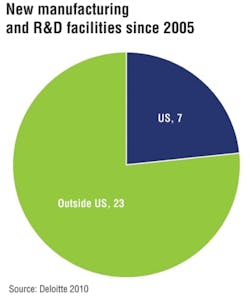
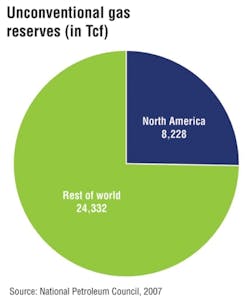
(Left) OFS companies are moving some of their sustainable R&D, sourcing, manufacturing, testing, and assembly to countries with lower cost of operations. (Right) Looking ahead 5-10 years, shale plays may not just be a US phenomenon, given potential unconventional gas reserve estimates outside the US.
In oilfield equipment manufacturing, it is not unusual for “sustainable” R&D to be tied closely to manufacturing; and therefore to locate where manufacturing is located. This also can help decide what portion of the R&D budget can be centralized versus what can be pushed down to the business units. Centralization of a portion of the R&D budget can help drive out potential redundancies and encourage synergistic solutions. Furthermore, it can help focus company efforts on what R&D will lead to the biggest bang for the buck across multiple business units.
Finance and taxes
Areas that often get left out or added too late in the restructuring process are tax and financial considerations such as tax optimization, legal entity restructuring, and optimal use/flow of cash around the globe, including possible repatriation. Many times, what is most optimal from a business perspective may not result in the lowest effective tax rate. Secondly, what is most efficient from a tax perspective may not be optimal in case cash needs to be repatriated back to the home country and/or moved around with the least amount of “friction” to fund growth in regions across the globe.
For example, some companies repatriate cash to the US to either fund other significant growth or to meet fixed obligations while facing flat or declining revenues. It is important that the legal and tax structure be considered in the deployment of cash and other resources over time. Establishment of cash management and funding mechanisms can reduce the “friction” of moving cash to where it is needed.
A best practice is that tax and cash optimization should be aligned with business strategy and business needs. Approaching the problem in the reverse order can have unintended consequences and is not recommended in the current regulatory climate. Business restructuring combined with appropriate financial and tax planning can provide benefits that are multipliers of any single benefit in isolation.
Notoriously cyclical
Consider “Newton’s Oil and Gas Law”: What goes out of the US could come back...but in a different form!
Let us not forget that the oil and gas business is notoriously cyclical: shale plays in the US are a growth story for at least the next few years, while the China growth story could slow. Service companies should carefully segment their business, understand where there could be growth and contraction by product/service/geography, and use that information to decide on what should move where, to build flexibility into corporate restructuring plans, and have strategic and tactical “outs” to mitigate downside.
One significant challenge of a large corporate restructuring is to motivate people to “buy-into” the program and to execute the plan. This requires communication, incentive alignment and accountability, gaining momentum and credibility through the “quick-wins” and supporting leadership from the top.
In summary, this is corporate restructuring with a twist – a comprehensive restructuring of business taking into account finance and tax considerations and ensuring success by incorporating strategic flexibility and total accountability.
About the author
Chuck Chakravarthy is a director in the Oil & Gas Strategy practice at Deloitte Consulting LLP, where he leads the US Performance Improvement Initiative for Oil & Gas. Chakravarthy has more than 17 years of experience in all parts of the energy value chain. He joined Deloitte in September 2008 and previously held partner and regional practice lead positions in energy strategy at Accenture and BCG. His experience includes 10 years as a consultant advising on large business transformations, M&A, supply chain restructurings, and portfolio optimization; four years as a director at a major energy merchant bank; and four years as a chemical and environmental engineer.
Chuck Chakravarthy
Deloitte Consulting LLP
Offshore Articles Archives
View Oil and Gas Articles on PennEnergy.com