Drilling & Production
Aging North Sea wells
A UWG Ltd. study of structural integrity of aging offshore wells in the North Sea and the increasing concerns among operators reveals that 83% of operators of more than 6,000 wells in the United Kingdom continental shelf (UKCS) are experiencing problems associated with well structural integrity (SI), and 87% of these operators expect that this incidence will continue to rise.
According to John Westwood, industry analyst with Douglas-Westwood Ltd. (DWL), his company compiled information from 18 oil and gas companies that operate more than two-thirds of the wells drilled to date in the UKCS. Westwood adds that 10% of the wells in that region have been shut in because of SI concerns at some point during the last five years.
“The report has brought the question of well SI right out into the open,” says Kevin Burton, managing director of UWG and vice president of Acteon’s Conductor Systems Division. “It has confirmed our belief that, as an industry, more emphasis needs to be given to ensuring the SI of wells during construction and to overcoming any problems that present themselves later in a well’s life cycle.”
Westwood adds, “DWL was commissioned by UWG for this study to raise industry awareness as to the nature, scale and potential impact of SI of offshore wells on the UKCS.” The work consisted of an analysis of UK well data and a survey of 18 operators responsible for 6,137 of the 9,196 wells drilled on the UKCS prior to the end of January 2005.
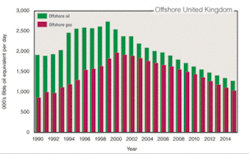
“A contrast in the forecasts of the nature and level of future exploration and production activity within the UKCS indicates that while production from many of the offshore oil and gas fields is now in decline, strong prospects remain for sustained activity in the area,” Burton says. “Industry’s thought is currently focused on re-evaluating and extending the operational lifetimes of existing wells and facilities supported by government initiatives to sustain production and maximize economic recovery in the sector.”
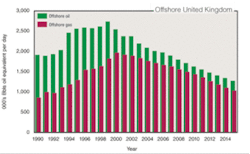
He advised that as the region’s operational infrastructure moves beyond its intended productive life, concerns are growing over safety, productivity, and environmental standards. Issues of SI have become increasingly pertinent concerns for industry as exploration and production activity is likely to be sustained into the next decade and beyond. As UKCS decommissioning activity continues to be delayed, and the movement toward extending the life of mature assets and developing previously untapped reserves continues to gather momentum, an increasing reliance on existing, aging infrastructure is developing.
“The growing maturity of offshore infrastructure within the UKCS, according to a survey, indicates that 1,190 of the 3,372 currently completed wells were completed more than 20 years ago, and other wells in operation were completed up to 38 years ago,” Burton says. “Of this number, all but 15 of the wells are believed to be operated by 15 operators who collectively account for 64% (or 9,156 MMboe) of remaining UKCS reserves.”
However, there seems to be no real knowledge of what happens in operating wells beyond their design lives with particular concern surrounding safety, environmental, and economic standards associated with the SI of these offshore wells.
Balancing challenges
Burton says that each stage of a well’s life cycle is a challenge for operators as they seek to balance the need to maximize economic recovery from their assets with their obligations for safe and environmentally-sensitive operations as presented in the 1996 Offshore Installations and Wells Regulations. The challenges relate to the well’s SI and related reservoir management issues, which have lead to a growing number of UKCS wells being suspended, shut in for maintenance, or prematurely plugged and abandoned in recent times.
“Definitions and interpretations of the term SI vary significantly depending upon the structure in question and its intended application,” Westwood says. “For the purposes of this study, it has been taken to mean the soundness, strength, stability, and general operability of the well, including the well conductor system within which a conductor is defined as being the main outer structural tubular.”
Up to now, these issues have been perceived as being of minor importance. However, Burton says that as a result of SI, 10% of UKCS wells have been shut at some point over the past five years. Approximately 83% of the operators DWL personnel interviewed currently are experiencing some form of SI problem on their wells. About 87% believe the incidence of SI problems on the UKCS is increasing, and will continue to do so into the future. These problems are a result of a combination of the sale of old wells, an associated extension of well design lives, and a general lack of attention to system design and maintenance in the past.
“The most frequently reported SI problems have been centralization and corrosion within the well conductor system, tubing leaks, and valve failures,” Burton says. “Other common issues include annulus pressure, connector failure, scale, conductor wear, wellhead growth, and christmas tree leaks.”
Age is the primary cause of the SI problems with UKCS wells that incorporate the combination of erosion, corrosion, and general fatigue failures associated with prolonged field life.
“The wells exceeding their design lives, together with the poor design, installation, and integrity assurance standards associated with the aging wells, has led to an increased frequency of problems,” Burton says. “These problems are accelerated by increasing levels of water cut, heat treating, and gas lift later in the field life. However, there remains a consensus that although age is undoubtedly a significant issue, if it is managed correctly, it should not be a cause of structural integrity problems which may restrict, or indeed cease, production.”
UWG believes that the transfer of aging assets has resulted in an increasing incidence of problems due to a potential loss of asset-specific knowledge and cost cutting in the mature phase of production. The changing of ownership within the UKCS could extend the productive phase, but only time will tell how successful the new operators will be in producing the associated wells and facilities beyond their intended design lives.•
