3D multiple attenuation compensates for irregular Black Sea bed
Stephen McHugo, Bruce Webb, Tatiana Grechishnikova, Richard Whitebread - WesternGeco
Complex seabed topography is common in many deepwater fields around the world and gives rise to complex multiple regimes that are poorly attenuated by 2D multiple attenuation algorithms. A new approach to 3D multiple attenuation was used to attenuate complex multiples from 3D surveys at Tuapse field in the Black Sea which has a complex water bottom geometry. The new method compensates for irregular sampling in acquisition so the input data does not have to be manipulated and preconditioned to meet the stringent requirements of ideal 3D surface related multiple elimination (SRME).
Surface related multiples are generated on seismic data as the primary wavefield is replicated and reversed at a strong reflecting interface. There are many multiple regimes set up during towed marine streamer acquisition, the most dominant of which usually are formed in the water column. For these water bottom multiples, the generators are the interfaces between the air/water and water/seafloor.
SRME is the most powerful data-driven method to predict and to attenuate multiples from seismic data, and is performed in two phases. The first phase involves creating a multiple model for each target trace. The second phase involves adaptively subtracting the multiple model from the input data, using filters derived using a least-squares approach. The basic principle is that multiple reflections can be constructed from a number of primary reflections convolved together, and the recorded seismic data contains all the required information to estimate (or predict) the multiples.
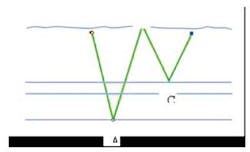
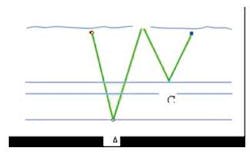
- The multiple ray path recorded between source (S) and receiver (R) is shown in green
- The seismic ray leaves the shot at point S, is reflected from a primary reflector at point A
- The ray is transmitted to surface where it strikes the air-water interface at point B
- The ray is then reflected downward to the seabed where it is reflected back at point C and finally received by receiver at point R.
The multiple ray can be considered to be composed of two primary paths: SB and BR. Point B is known as the downward reflection point (DRP). To calculate the multiple model for this simple example using SRME, we need a source and receiver at position B so that the two components of the raypath (upcoming and downgoing) are present. Convolving traces SB and BR give an estimate of the multiple for this target trace.
To predict the multiples this way, one must acquire shots and receivers at coincident locations. However, this is impossible in the marine environment because of efficiency and operational reasons. For 2D implementation of SRME, this harmonization of the shots and receivers can be achieved during processing through interpolation. In addition, the method requires that the water bottom reflection be recorded and available at zero offset. Extrapolation to zero offset is performed prior to multiple prediction to achieve this. In practice, for any target trace, which traces need to be convolved to form the multiple is unknown, so all traces are convolved and the multiple model is formed by stacking the convolved traces. For the 3D implementation of SRME, however, the situation is more complex because the multiples are generated with 3D raypaths that can fall anywhere within a spatial aperture dictated by the geology. Hence, reconstructing traces is much more difficult.
When seabed geology is simple, the water bottom multiples lie within the plane of the sail line direction and can be predicted and attenuated through 2D multiple attenuation schemes, which only require information from single subsurface lines. However, if the water bottom is complex or dips in the crossline direction, the multiples fall outside the plane of the acquisition sail line direction and can be predicted only using a 3D approach. This is shown below.
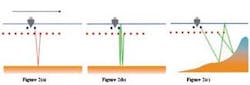
Figure 2(a) shows front view of a 10 streamer seismic survey showing relative positions of the seismic sources and detectors. The primary reflection from the water bottom is shown by the ray in red. Figure 2(b) shows the raypath of the first order multiple from the flat water bottom, in green, the multiple ray path is in roughly the same plane as the sail line direction and can be estimated from 2D data. Figure 2(c) shows what happens to the multiple on a complex, steeply dipping bottom. The downward reflection point (DRP) of the first order multiple lies outside the plane of the sail line direction and accurate prediction requires information from other cables and adjacent swathes to predict the multiple.
WesternGeco’s new multiple prediction method, 3D General Surface Multiple Prediction (3D GSMP), enables a high quality 3D multiple prediction for surveys in complex geology and with irregular acquisition geometry. An important feature of this method is its ability to predict multiples at true azimuth, taking the true raypath of the multiple through the water layer into account. The sensitivity of multiple prediction to azimuth and other issues relating to 3DSRME are discussed by Moore and Bisley (2005). Unlike other implementations of 3D SRME, there is no requirement to regularize, to extrapolate to zero offset, or interpolate the shot and receiver sampling intervals prior to 3D GSMP.
In reality, any seabed irregularity can lead to greater or lesser extent to 3D multiple ray paths. For example, 3D multiple diffractions can be produced by small, localized seabed anomalies and can produce multiple diffraction curves in 3D space which cannot be modeled in 2D space. As 3D multiple attenuation techniques become established, they will became standard practice. Some 3D schemes also are required in the presence of irregular acquisition geometry (e.g. high feather) because the variation of seismic raypaths introduces timing errors during multiple prediction.
Case study background
The Tuapse 3D survey in the Black Sea comprises 1,200 sq km (463 sq mi) and was acquired for exploration purposes using Q-Marine single sensor acquisition system in August and September of 2007. The survey used point-receiver acquisition technology, and the shot and streamers were towed at shallow depths of 6 m (19 ft) and 7 m (23 ft) respectively. Ten cables of 6,000-m (3.7-mi) length were deployed at a separation of 100 m (328 ft): the inline spacing between point receivers was maintained at 3.125 m (10.25 ft) single-sensor trace interval to compensate for perturbations and attenuate noise introduced during acquisition, and shot domain processing was performed at a 2 ms sample rate. The processing at single-sensor trace interval included receiver motion correction and attenuation of swell-induced cable noise and waterborne noise. Shot-by-shot designature using calibrated marine source designature minimized wavelet distortion arising from variations in source characteristics. Digital group forming incorporating a digital antialias filter to 12.5 m (41 ft) trace interval and temporal resample to 4 ms was performed prior to input to 3D GSMP.
The need for 3D multiple attenuation
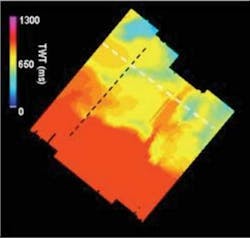
The water bottom two-way-time map illustrates that in the eastern half of the survey the bottom is complex and in places dips steeply to the north. There also is evidence of irregular topography caused by canyons and infilled channels which can be up to 300 m (984 ft) deep relative to the average water depth. There is up to 800 m (2,625 ft) of variation in water bottom depth across the survey, giving TWT variation of 1000 ms across the survey area. The dipping nature and irregular 3D topography of the water bottom gives complex multiple reflections and diffractions whose raypaths lie outside the plane of the acquisition sail-line direction.
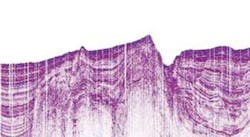
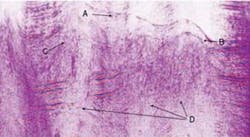
Illustrated is an in line section at the location indicated by dashed black line. The main target zone is indicated by the thick double headed arrow. The target is obscured by four main classes of multiple energy
- The first water bottom multiple bounce at twice the two-way-time of the water bottom
- Multiple bounces from the event just below the seabed
- Multiple diffractions
- Scattered multiple energy.
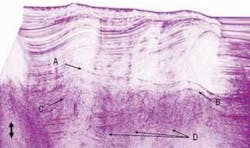
Because of the nature of the water bottom, all the multiples have 3D expression and can only be attenuated fully through a 3D prediction scheme.
3D multiple analysis
As indicated for 3D GSMP, the multiple model for each target trace is predicted by computing a multiple contribution gather (MCG).
The two main parameters affecting the quality of the multiple prediction are the density of sampling within an MCG and the crossline aperture width. Both parameters also impact the cost of the multiple prediction and must be selected carefully to achieve a result that is geophysically correct but also meets the financial constraints of the project.
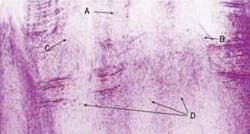
MCGs are created and stacked for every prestack trace in the seismic survey, giving a multiple model which is subtracted from the input data using a least-squares adaptive subtraction technique.
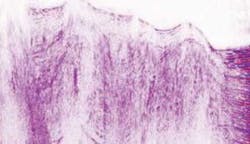
null
Can 2D solve the problem?
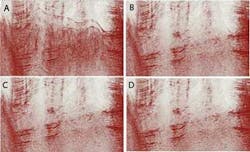
The results from 3D GSMP were compared against 2D SRME multiple attenuation. Prior to 2D SRME, the data were interpolated to give a symmetrical shot and receiver spacing of 12.5 m (41 ft). The data also were extrapolated to zero offset for a water bottom reflection at zero offset which is a requirement of 2D SRME.
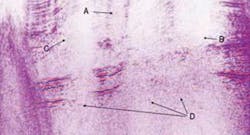
The 2D SRME results show the first order water bottom bounce has been largely attenuated by the 2D approach. However, the multiple energy from the near seabed reflectors has been attenuated only partially and still obscures the target zone. There also is significant residual multiple energy in the form of scattered multiple energy and multiple diffractions which the 2D scheme did not model and remove.
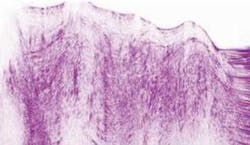
The 3D GSMP results show it successfully removed both the water bottom multiple and the scattered multiple energy generated by the complex overburden in this area. The primary reflection energy underneath the multiple has been revealed, un-attenuated.
Suggestions for further reading
The following articles and technical papers contain more details about SRME and 3D GSMP:
Moore, I, R. and Bisley, 2005, 3D surface-related multiple prediction (SMP): A case history: The Leading Edge, 24, 270-274.
Moore, I. and Dragoset, W.H.[2008] General Surface Multiple Prediction (GSMP) – A Flexible 3D SRME Algorithm. EAGE Expanded Abstracts.
Acknowledgements
We thank Chernomorneftegaz for permission to publish this article. We also thank Bill Dragoset and David Hill of WesternGeco for their illustrations, and Ed Palmer of WesternGeco for his help editing this article.