GEOSCIENCES
Gene Kliewer, Houston
New Zealand starts third seismic survey
New Zealand’s Crown Minerals has started the government’s third seismic data survey. The program includes 2,200 km (1,367 mi) of 2D seismic data that will be acquired north of the Raukumara Peninsula off the east coast of the North Island and 300 km (186 mi) that will be acquired off the southern Wairarapa coast. It will comprise seismic, gravity, and magnetic surveys.
The survey is part of the government’s efforts to acquire data under a $15-million fund established in 2004 to increase petroleum exploration in New Zealand. Existing data show both areas contain features likely to be of interest to exploration companies.
“The data will be offered freely to explorers to promote and encourage petroleum exploration activities in the hope that it will lead to the discovery of new petroleum reserves,” says Crown Minerals Petroleum Unit Manager Mark Aliprantis.
“The level of interest being shown by exploration companies in this government program is most encouraging. We believe this program, coupled with changes to royalty rates and the tax treatment of exploration workers, is proving successful in raising interest in New Zealand as an exploration destination.”
Senegal seismic data under study
Senegal Hunt Oil Co. has completed acquisition and onboard processing of Samgomar Deep 3D seismic data, says partner First Australian Resources Ltd.
The stacked data volume and a velocity data file have been sent to Spectrum in the UK where the onboard cube is being migrated. Field tapes have been sent to CGG in Houston, where full processing of the data volume is being performed. Cost of the 2,089-sq-km (807-sq-mi) survey was $12.1 million.
Wavefield to conduct Uruguay survey
The Uruguayan Ministry of Energy and Environment has contracted Wavefield Inseis to conduct a multi-client long-offset 2D survey covering 7,000 km (4,350 mi).
Wavefield plans to use the M/VBergen Surveyor with an 8,000-m (5 mi) streamer. Marine gravity and magnetic data will be recorded also. The result of final processing is scheduled to be available by year-end.
Uruguay’s state company Ancap is a partner and will share any revenues from sales of the information to oil companies.
“The Uruguay sedimentary basins are composed of rocks of Paleozoic to Mesozoic ages and were deposited in the pre-rift, sin-rift, sag, and passive margin stages,” says Jan B. Gateman, senior VP G&G of Wavefield. “Existing wells drilled on structural highs in the Punta del Este basin proved that these sediments are within the hydrocarbon generation window. In both the Punta del Este and Pelotas basins, several leads of structural and stratigraphic character have been identified on older seismic data. These hydrocarbon leads are located in a wide range of water depths.”
The survey data will be promoted together with a comprehensive interpretation study that will tie and calibrate the geology of the offshore basins of Uruguay with the neighboring basins in Brazil and Argentina.
New seismic company orders four vessels
Newly formed Eastern Echo has ordered four seismic vessels of the Ulstein SX124 design to be built at Barreras shipyard in Vigo, Spain. First delivery is scheduled for the end of 2008 with the remaining ships following in 2009.
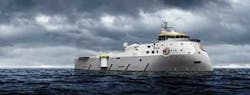
These will be the first seismic vessels of Ulstein design and will be built with the Ulstein X-bow. All four are to be equipped for 3D seismology and are to have up to 10 streamer winches each.
“Most of the main equipment is also delivered by Ulstein Design,” says Lars Ståle Skoge, sales manager for Ulstein Design. “The contracts amount to approximately NOK 400 million ($66 million). “Many of the project’s financial backers are Norwegian, as are many of Ulstein Design’s subcontractors. Ulstein Elektro has extensive system deliveries, and ODIM will be supplying a complete handling solution for seismic equipment.”
“We are convinced this will be a good design for us, particularly with regard to the environment,” says Peter Zickerman of Eastern Echo. “It is very important to us that the crew have good, safe working conditions, and we believe this design will be an important contribution towards that end.”
Shell, Techsia to develop reservoir software
Shell International Exploration and Production BV and Techsia SA have agreed to jointly develop and implement Techsia’s petrophysical software Techlog. Techlog is a reservoir characterization program to analyze and interpret log and core data.
“Techlog will help us to develop and implement further new applications,” says Hans de Wall, global head of petrophysics for Shell. “We are already seeing its impact on project cycle times and look forward to further benefits, using the Techlog platform.”
The Techlog software suite is being enhanced in two phases according to the agreement:
- Phase 1 is aimed at meeting the fundamental petrophysical workflow requirements, producing benefits in the data model, depth/time reference management, connectivity, user programming capabilities, multi-well layout performance, and hierarchical parameter management.
- Phase 2 is expected to develop the functionalities of the Techlog platform beyond the industry standard offerings, by integrating Shell’s petrophysical tools.
Ultera, Sercel partner on data recorder
Ultera Systems Inc. and Sercel have partnered to market and support the Mirage Data Recorder (MDR), designed for real-time data acquisition.
“We are constantly evaluating data acquisition technology to ensure we offer our geophysical clients the fastest, most reliable equipment available,” says Daniel Boucard, product development manager for Sercel. “We recently completed testing and evaluating Ultera’s Mirage Data Recorders and certified that they meet our stringent standards for quality, accuracy, and reliability. As a result, we are excited to resell MDRs globally.”
“This agreement with Sercel is a major step forward in our efforts to sell Ultera products internationally,” says Ultera President Mo Nour. “Sercel is the largest manufacturer of seismic acquisition equipment in the world. We anticipate providing product immediately.”
The MDR features built-in redundancy to ensure recording if one of the drives fails. Once recorded, automatic write protection prevents accidental data erasure. For extra protection, the identical tape volumes stored on transportable hard drives allow field technicians to take one to the base camp for processing or archiving to conventional tape cartridges while retaining the other hard drive as a backup.
The MDR’s high-capacity disks store more data on a single volume, the company says. A single MDR disk is equivalent to up to 70 tape cartridges. Each drive can be configured to accept 10 to 70 IBM 3590 tapes, or up to seven LTO format tape cartridges.
