Drilling & Production
Frank Hartley • Houston
Remote conductor torquing system
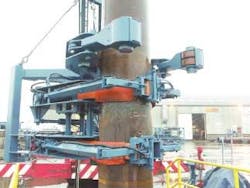
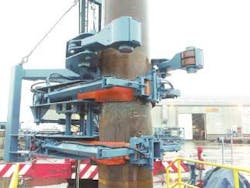
BJ Hammer Services has developed a new remote conductor torquing system that it says improves safety and operational efficiency when making up or breaking out conductor-threaded connections.
Effective make-up and breakout of threaded conductor connections are critical to conductor (pile) driving operations. With a 7,000-lb/ft spinner, BJ's conductor torquing system can deliver 150,000 lb/ft of torque. As a result, conductor connection make-up and breakout and driving operations are efficient and safer, the company says.
The system is designed to operate remotely at high torque levels. Only one technician is required to operate the unit from a control unit, so personnel aren't required to work in close proximity to the rotary table, Andy Penman, Hammer Services manager for BJ Tubular Services, says. Penman says that running costs are lower because fewer personnel are required.
The conductor torquing system and spinner are designed to handle pipe with special care. In addition, the make-up system is consolidated into one unit, eliminating the need to assemble the unit before a make-up or break-out operation.
null
Rapid-assembly fittings
Parker Instrumentation has completed its family of rapid-assembly 15,000-psi compression tube fittings. With the release of 15 new component shapes, Parker offers flow arrangements designed to provide a single-piece solution for common connection requirements.
Using a compression sealing technique that assembles in seconds, Parker's MPI fittings save an estimated 20 min per connection, or $10 of labor cost, the company says. The new fittings are resistant to vibration, which Parker says will eliminate the cost of the vibration gland used with cone-and-thread fittings.
The tube fittings are available in sizes to fit tubing with outside diameters from 1/4 to 3/4 in. The fitting shapes, such as straight connections, elbow, and tee joints, are extended with a number of flow arrangements and adapting interfaces.
Among the additions are tube versions in straight or 45° and 90° elbow shapes. A variety of adapting options combine an MPI tube stub end with a connector for existing instrumentation. These include NPT pipe threads, flare connections, SAE O-ring connectors, and traditional cone-and-thread. A similar collection of straight connector adaptors allow the addition of a variant for high-pressure hose connections.
The fittings may be used on cold-drawn hard (unannealed) 316 stainless steel tubing, or thick-walled (annealed) instrumentation-grade 316 tubing. The fittings feature nuts coated with molybdenum disulfide, which provides a long-lasting lubricant to help prevent thread galling and reduces the torque required to create the seal.
The fittings can be used in deepwater oil and gas drilling, methanol injection equipment, and industrial laboratories where products are developed and tested under extreme conditions.
A combination of design factors allowing operation at much higher pressures include new geometries for the ferrules, which create a dual mechanical hold onto the tubing wall; the application of the Suparcase hardening treatment to both ferrules for enhanced ability to bite into tubing; longer tube supporting areas within the fittings to enhance resistance to vibration and line loads; and the use of 'inverted' threads (swapping the sides on which male and female threads are used). This latter technique allows pressure-retaining elements of the tube fitting to be made thicker without substantially increasing either the size or weight of the fittings.
Record PDC bit run in the North Sea
Varel International and ChevronTexaco have used Varel's 12 1/4-in. BB657XCB polycrystalline diamond compact (PDC) bit on Chevron's Alba North A-50 well in the North Sea for a single run of 15,472 ft, with an average rate of penetration of 94.5 ft/hr.
The bit design incorporates oval cutters and lateral jets and was chosen for its performance in drilling hard limestone stringers, Chevron said. Baker Hughes Inteq ran the bit, which was downhole for two weeks, on its AutoTrak rotary closed-loop drilling system. After completing the build to 81°, Baker drilled the well tangentially for approximately 11,000 ft. The company then built a well profile to achieve the geological objectives in the reservoir sands. Baker encountered more than 30 hard limestone stringers and drilled with the BB657XCB.
Baker Hughes Inteq has confirmed this to be its longest single-bit run on AutoTrak. Varel believes this to be the longest 12 1/4-in. PDC- bit run in all sectors of the North Sea, and possibly a world record for the longest single-bit run on a rotary steerable system.
The bit is being refurbished to "as new" condition at the Varel manufacturing facility in Pau, France for use on future Alba North wells.