GEOSCIENCES
New equipment and technology
CGGVeritas has its new seismic vessel Oceanic Vega in hand now. The vessel is co-owned with Eidesvik . CGGVeritas says initially it will have 16 Sercel solid Sentinel streamers onboard, and that it has the capacity to tow up to 20 streamers. It features Nautilus acoustic positioning and streamer steering in an Ulstein SX120 design, ice-class vessel.
Spectraseis has released RioGrande, a data management and visualization program for low-frequency seismic data. The company also said it plans to release a LF seismic plug-in for Schlumberger’s Petrel this fall. Spectraseis says it is driving toward full integration of low-frequency seismic with conventional data.
RioGrande provides an integrated tool to simplify management and analysis of LF survey data, says Spectraseis. It starts with a general information viewer that holds the relevant station details and measurement logs, and extends to data-specific viewers, including a 3D map viewer, a measurement time line viewer, an image viewer, a raw data trace viewer, and a Synchrogram viewer for multiple spectrograms.
RioGrande can browse, search, and view all LF seismic acquisition and processing data – everything from survey points through to quality assessments and spectrograms – for each recorded measurement. The integration of external information provides the operator with a richer data set for interpretation.
The program is available to Spectraseis customers only at present, but may be made available as a stand-alone program in the future.
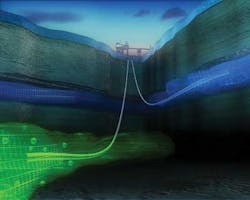
The fall release of the Petrel plug-in will allow integration of LF survey data and analyses with conventional data such as 2D/3D seismic, well logs, and reservoir models within Petrel.
The second-generation ocean-bottom cable acquisition tool VectorSeis Ocean II now is available commercially, saysION Geophysical Corp. Enhancements to the buoy-based system include continuous recording; advanced diagnostics, and reporting tools; and better power delivery which increases recording time.
“We are excited about the enhancements in VSO II as well as our ability to offer the system to all service providers in the market,” says Tim Rigsby, senior VP of Strategic Initiatives. “This will allow even more E&P operators and contractors to access a technology we believe improves the operational safety and efficiency of seabed acquisition while providing the best data quality available on the market.”
Stingray Geophysical and Ikon Science say they plan to develop new time-lapse technology and services together. The new technology is to use multi-component sensors permanently installed on the seabed to monitor fluid, pressure, and geomechanical changes during production. Combining time-lapse seismic and production data into a 3D geological model can help predict changes that can be validated with 4D seismic modeling, Stingray says.

As part of its current data acquisition program, New Zealand collected 2,375 km (1,476 mi) of 2D seismic over the Campbell Plateau and Bounty Trough last summer. The raw data is available to interested parties, and the government says it will process and interpret this new seismic data over the coming months, aiming toward a Block Offer over the area later this year or early 2011. The government is also releasing 5,934 km (3,687 mi) of recently reprocessed 2D seismic data collected during the 1970s and 1980s by Hunt Petroleum.
CGGVeritas and Petrobras are going to collaborate on the development and implementation of new technologies in geophysics. The companies have signed an agreement to use the newly opened CGGVeritas Technology Center in Rio de Janeiro, Brazil, to work on projects such as 4D seismic processing, imaging, and reservoir geophysics.
Schlumberger has a new Website called “Ocean Store” at www.ocean.slb.com where users can browse, buy, and download software plug-ins for Petrel developed by a variety of sources. Further, software developers can use the Ocean platform infrastructure to develop more new capabilities faster.
“The Ocean platform allows developers to rapidly innovate to solve these tough challenges, enabling oil and gas companies to deploy and use new technologies much faster,” says Tony Bowman, president, Schlumberger Information Solutions. “The store provides access to a growing set of capabilities that extend the already broad Petrel platform.”
Ireland, Newfoundland linked geologically?
Perhaps taking a page out of the eastern South America and western Africa geologic similarity investigations, Ireland has unveiled a new corroboration exercise involving research institutes in Ireland and Newfoundland-Labrador and private enterprise that aims to further frontier offshore exploration. The two-year research program will use advanced modeling software to generate plate reconstruction models designed to show Ireland and Canada’s sedimentary basins in their original positions when the two countries were nearer together. Ideally, the results will help geoscientists identify prospective areas offshore Ireland with similar geology. Over the last 30 years, around 150 wells have been drilled in the Irish Atlantic sector, with a commercial success ratio of less than 1 in 30. However, the area is thought to be potentially prolific in hydrocarbons, with reserves of 10 Bboe, according to Irish government estimates.
Offshore Articles Archives
View Oil and Gas Articles on PennEnergy.com