ATP converts semi for fast-track deepwater development
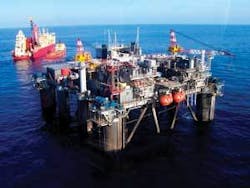
With limited infrastructure in the vicinity and an aggressive schedule to first production, ATP elected to develop its Gomez field in the Gulf of Mexico with a converted semisubmersible rig, a solution that hadn’t been used in the Gulf since 1995. “The nearest platform for tieback was over 48 km (30 mi) away, which would have introduced a lot of flow assurance problems,” says RM Shivers III, ATP vice president of projects and Gomez project manager. “It would have been costly, as well.”
The company installed the facility and turned on the taps within 16 months of project sanction, even with hurricanes Katrina and Rita bearing down on the company’s imminent goals.
Investment decision
“The idea was to find some means of developing Gomez that would, if the field was too small, protect our downside, but would still leave the door open in the event that the upside was there,” says Shivers. “Once you tie up money in a new investment, you’ve got no way of knowing if there are enough reserves in the field to pay it back,” he adds.
So that ruled out new construction.
The company determined that an obsolete semisubmersible drilling rig would do. But, of course, it needed to be in good condition. Rowan’s first generation MODURowan Midland fit the profile.
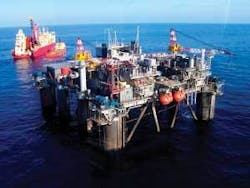
Initially, the semi was secured under an agreement where it would be used on a day rate basis. But after the Gomez well test was conducted with favorable results, the company decided to buy the facility. ATP plans to pay off the balance of its lease on Jan. 31, 2007, after which it will assume 100% ownership.
Fast-track conversion
TheRowan Midland MODU arrived at Signal International’s drydock in Port Arthur, Texas, on Sept. 18, 2005, for conversion into a production platform. After four months with over 100,000 man-hours logged, the semi was undocked and moved to Signal’s Texas South Yard in Sabine Pass for final outfitting.
Here the MODU’s derrick and associated drilling equipment were removed, leaving behind limited well intervention capabilities. The semi’s leftover drilling capacity can be used to perform minimal through-tubing work for re-entering wells situated beneath the floater, but it cannot spud new wells.
After a majority of the drilling equipment was removed, the semi’s production modules were installed. Omega Services of New Iberia, Louisiana, fabricated and supplied the process modules, which then fitted atop the semi’s upper deck with Horizon Offshore’s derrick barge,Pacific Horizon. Major installed process equipment includes HP, LP, IP and test separators, gas turbine compression, glycol compression, electrostatic heater treater, LACT, gas sales metering, and gas turbine generators.
The floater was then transferred to Signal’s yard in Pascagoula, Mississippi, for stability testing. The overall duration of the program for converting the drilling rig into a production facility was five months. The period of conversion work would have been reduced by one month without delays caused by hurricanes Katrina and Rita.
In early January, the converted semi was towed out and took up station in 914 m (3,000 ft) of water on Mississippi Canyon block 711.
SEPLA anchors
TheGomez semisubmersible floating production platform is permanently moored by a 12-point taut-leg mooring system with polyester rope, fixed to the seabed via suction embedded plate anchors (SEPLAs). The SEPLA is a patented InterMoor product. According to the supplier, this is the first time a floating production unit has used SEPLA anchors in the GoM.
The InterMoor supplied mooring system components include (from semi to seabed) about 213 m (700 ft) of 3.25-in. wire on 8 legs or 3-in. chain on 4 legs, approximately 1,323 m (4,340 ft) of 6.5-in. torque-matched polyester rope, followed by 183 m (600 ft) of 3-in. chain, subsea connectors, 61 m (200 ft) of 3-in. chain, and the SEPLA anchors.
According to InterMoor, SEPLAs are more cost-effective than the more traditional suction embedded anchors. This particular application also was among the world’s first to use polyester rope, which provides lower cost and better performance (lower tensions and semi offset) than conventional steel catenary systems.
The mooring system has a design life of 10 years and has enough capacity to withstand 200-year storm conditions.
At print, two subsea wells (No. 4ST1 and No. 6) drilled on the southern portion of MC 711 were flowing to the moored semi. Diamond Offshore’s semisubmersible drilling rig,Ocean Voyager, re-entered and completed the two wells. The platform’s gas compression and production capacity will be expanded to 200 MMcfe/d by mid-2007, to handle production from an additional 3-4 wells. Two of these wells are expected to be producing by mid-2007. ATP is 100% owner and operator of the Gomez development project.
David Paganie, Managing Editor